Did Babbitt Predict X-rays?
Edwin D. Babbitt linked X-rays to his earlier theory of psychic light. Compare what he actually claimed with Wilhelm Röntgen’s 1895 experiments.
In this article
The 1878 claim and the 1895 discovery
Edwin D. Babbitt’s 1878 book proposed an invisible light that could pass through opaque objects and supposedly make clairvoyance possible. After Wilhelm Röntgen discovered X-rays in 1895, Babbitt used the discovery to support his earlier view. His original account did not describe X-rays as a distinct physical phenomenon. [3][4][2]
The Principles of Light and Color by Edwin D. Babbitt
In the 1896 supplement to The Principles of Light and Color, Edwin D. Babbitt recalls his theory of clairvoyance and draws a parallel with the work of William Crookes, Wilhelm Röntgen and Thomas Edison. He also looks for a connection between the glow seen in cathode-ray experiments and Reichenbach’s proposed Od. [3][4]
Babbitt reproduces a newspaper account of Edison’s fluorescent screen. The report describes a visible outline on the screen and speculates about its use in surgery. Babbitt incorporates the instrument into his argument for higher grades of light. [4][5]
On a New Kind of Rays by Wilhelm Röntgen
In On a New Kind of Rays, Wilhelm Röntgen reports how different materials weaken the rays by different amounts. In a hand, the bones cast stronger shadows than the surrounding tissue. A photographic plate can record the result. [2]
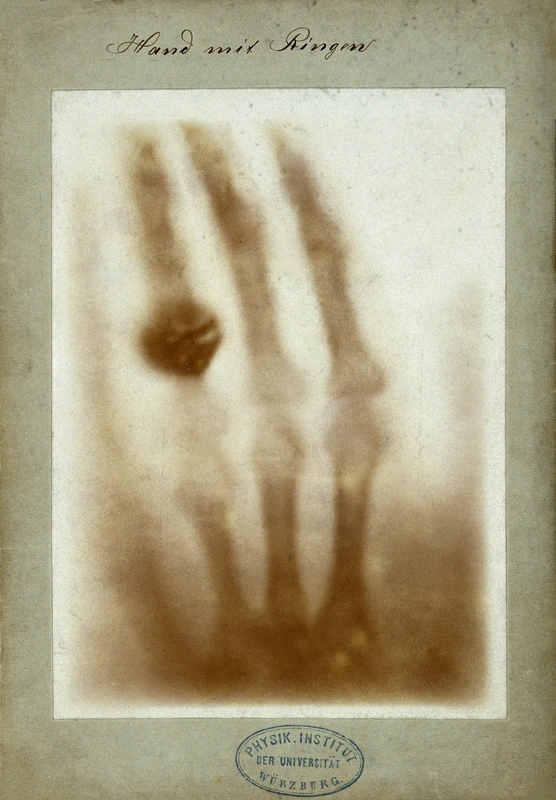
Wilhelm Röntgen’s December 1895 radiograph shows Anna Ludwig Röntgen’s hand. The bones and ring cast stronger shadows than the surrounding tissue.
Wilhelm Röntgen, Hand mit Ringen, December 1895. San José State University Digital Exhibits. · Image source ↗ · Public Domain
What each account used as evidence
Babbitt appealed to reports of inner vision to explain how someone might see through a solid. Röntgen varied the materials between the source and a screen and recorded how the image changed. Other observers could examine and reproduce that effect. [3][4][2]
In the library
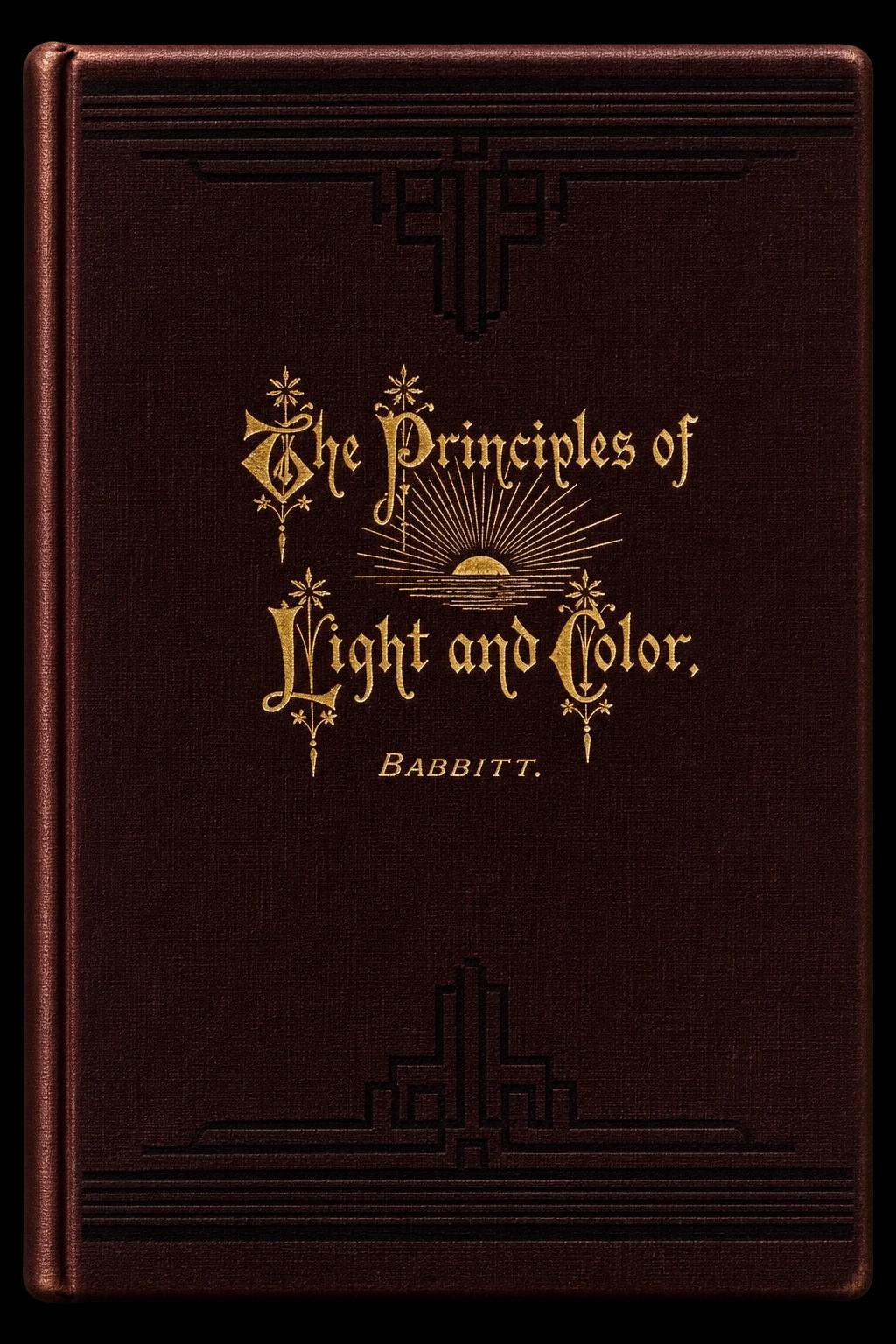
The Principles of Light and Color
Reading note
The separately titled account draws on exact passages in the consulted Library edition.
Sources
See references (5)
- Hand mit Ringen (1895) ↗Wilhelm Röntgen, Hand mit Ringen, December 1895. San José State University Digital Exhibits.
- On a New Kind of Rays, §§1–6 ↗Wilhelm Conrad Röntgen, translated by Arthur Stanton, Nature 53, pp. 274–276, 23 January 1896.
- The Principles of Light and Color, printed p. 462, Reader page 470Edwin D. Babbitt, The Principles of Light and Color, second edition, College of Fine Forces, East Orange, New Jersey, 1896. Lumitheca Library edition IMJ-0607-E001.Read this page in The Principles of Light and Color ↗
- The Principles of Light and Color, printed p. 559, Reader page 567Edwin D. Babbitt, The Principles of Light and Color, second edition, College of Fine Forces, East Orange, New Jersey, 1896. Lumitheca Library edition IMJ-0607-E001.Read this page in The Principles of Light and Color ↗
- The Principles of Light and Color, printed p. 560, Reader page 568Edwin D. Babbitt, The Principles of Light and Color, second edition, College of Fine Forces, East Orange, New Jersey, 1896. Lumitheca Library edition IMJ-0607-E001.Read this page in The Principles of Light and Color ↗