The Auric Egg
What is the auric egg in Western esotericism? Compare Hall’s symbol of the person between lives with Leadbeater’s account of a luminous ovoid.
In this article
A person within an ovoid
The auric egg is an esoteric image of the person within an oval envelope. Some authors use it to describe several subtle bodies occupying the same space. Others use the enclosure to think about what is said to persist between embodiments. [3][4][2]
Man the Grand Symbol of the Mysteries by Manly P. Hall
In Man the Grand Symbol of the Mysteries, Manly P. Hall calls the aura a microcosmic egg. The world egg contains a cosmos, and the smaller egg encloses a human life that he treats as a world in its own right. [5][6][3]
Hall uses the image to describe withdrawal and return. The forces supporting outward life withdraw into an auric body, and the person is said to remain in invisible bodies before taking on a new form. Hall also imagines the breaking of the egg as the eventual passage from individuality to unity. [3][4]
Man Visible and Invisible by C. W. Leadbeater
In Man Visible and Invisible, Charles W. Leadbeater describes the causal body as an ovoid. He says the astral and mental material gathered around an incarnation takes on that shape, as he believes a clairvoyant observer would see it. [2][7]
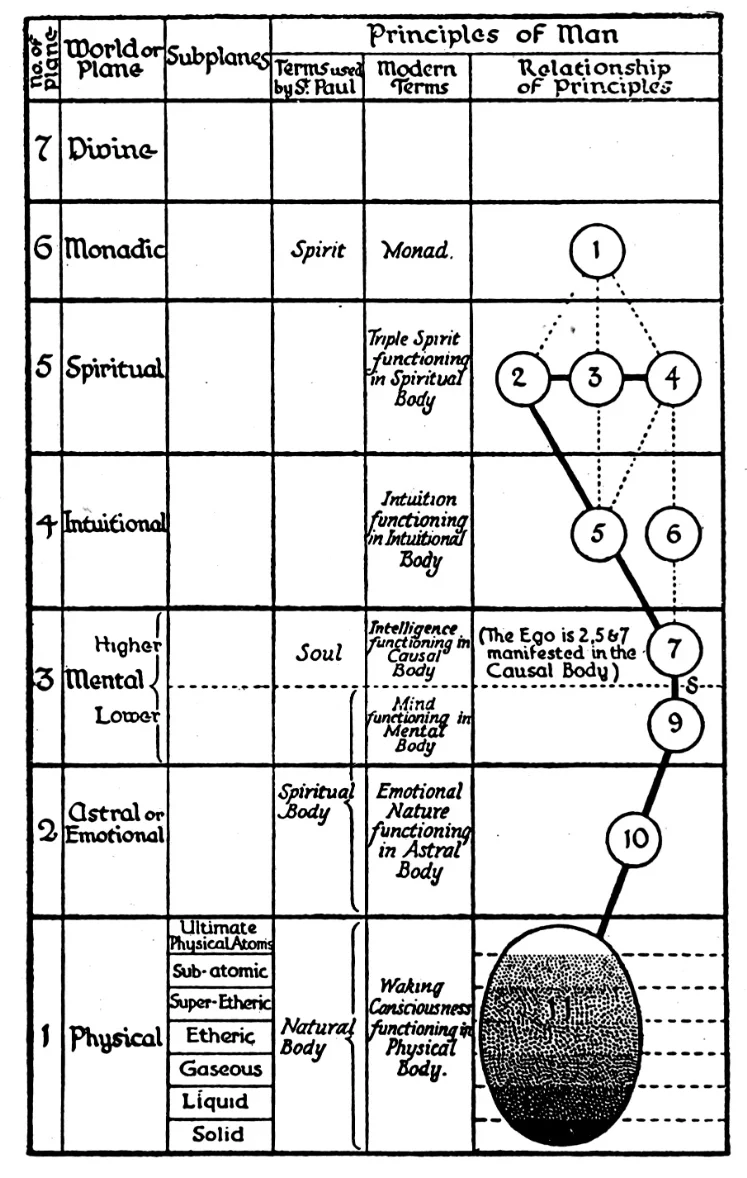
In The Science of the Sacraments, Leadbeater diagrams the causal body alongside related principles. The chart comes from a separate work.
The Science of the Sacraments by Charles W. Leadbeater, The St. Alban Press, 1920. Library facsimile. · Image source ↗ · Public Domain
The shape and the interval
Leadbeater explains why the subtle bodies supposedly present an ovoid shape. Hall uses the same shape to describe what he believes happens between embodiments and at eventual release. [3][4][2]
In the library
The Science of the Sacraments
Reading note
Separately attributed primary Library account, cited on exact verified Reader leaves.
Man the Grand Symbol of the Mysteries
Reading note
The separately titled account draws on exact passages in the consulted Library edition.
Sources
See references (7)
- The Science of the Sacraments, printed p. 546, Reader page 568Charles W. Leadbeater, The Science of the Sacraments, The St. Alban Press, 1920. Exact Library edition IMJ-0615-E001.Read this page in The Science of the Sacraments ↗
- Man Visible and Invisible (1903), chapter X, printed p. 64 ↗C. W. Leadbeater, Man Visible and Invisible, chapter XI, Theosophical Publishing Society, 1903. Digitized edition.
- Man the Grand Symbol of the Mysteries, printed p. 122, Reader page 120Manly P. Hall, Man the Grand Symbol of the Mysteries, Fourth Edition, The Philosophers Press, Los Angeles, 1937. Lumitheca Library edition IMJ-0603-E001.Read this page in Man the Grand Symbol of the Mysteries ↗
- Man the Grand Symbol of the Mysteries, printed p. 123, Reader page 121Manly P. Hall, Man the Grand Symbol of the Mysteries, Fourth Edition, The Philosophers Press, Los Angeles, 1937. Lumitheca Library edition IMJ-0603-E001.Read this page in Man the Grand Symbol of the Mysteries ↗
- Man the Grand Symbol of the Mysteries, Reader page 85Manly P. Hall, Man the Grand Symbol of the Mysteries, Fourth Edition, The Philosophers Press, Los Angeles, 1937. Lumitheca Library edition IMJ-0603-E001.Read this page in Man the Grand Symbol of the Mysteries ↗
- Man the Grand Symbol of the Mysteries, printed p. 88, Reader page 86Manly P. Hall, Man the Grand Symbol of the Mysteries, Fourth Edition, The Philosophers Press, Los Angeles, 1937. Lumitheca Library edition IMJ-0603-E001.Read this page in Man the Grand Symbol of the Mysteries ↗
- Man Visible and Invisible, chapter XIV, paragraph 157 ↗C. W. Leadbeater, Man Visible and Invisible, chapter XI, Theosophical Publishing Society, 1903. Digitized edition.