Attending one’s own funeral
In Gone West, two narrators attend their own funerals. For H. J. L. it is a farewell, while W. A. only gradually realises who is being buried.
In this article
Understanding attending one’s own funeral
Attending one’s own funeral is a motif in afterlife literature: a person is said to watch the burial of the body they have left. The scene can be the moment they realise they have died, or a chance to say goodbye to a life they already know has ended. [1][2][3]
J. S. M. Ward’s Gone West tells the scene from both sides of that difference. H. J. L. returns with a guide and knows whose funeral it is. W. A. works out what has happened from the coffin, the procession and the burial. [1][2][3]
Gone West by J. S. M. Ward
In J. S. M. Ward’s Gone West, H. J. L. is surprised when his guide announces that it is time for the funeral. He feels he has spent a long period studying, while only three earthly days have elapsed. The episode begins by separating the experience of time from the calendar followed by the mourners. [1]
At his former home, H. J. L. thinks the body looks like a sculpture. He moves among the mourners, who do not recognise him. When he sees Ward looking at the body, he tries to signal that he is still there and well. [1][2]
The guide describes the visit as a farewell to a familiar companion. He also says the spirit can remain attached to the body, and gives protection as another reason to attend. H. J. L.’s response puts the emphasis on how remote his former body already feels. [1][2]
After the burial, H. J. L. remains until the grave is filled and then returns to school. Its class has hardly advanced, reinforcing the discrepancy between earthly time and his new experience. The funeral becomes a temporary return to a life whose concerns now seem small to him. [2]
W. A.’s later narrative begins in confusion. He recognises a coffin only gradually, follows a dreamlike journey to familiar surroundings and sees the burial before returning with the mourners to his house. His recognition and early distress differ from H. J. L.’s more settled farewell. [3][4]
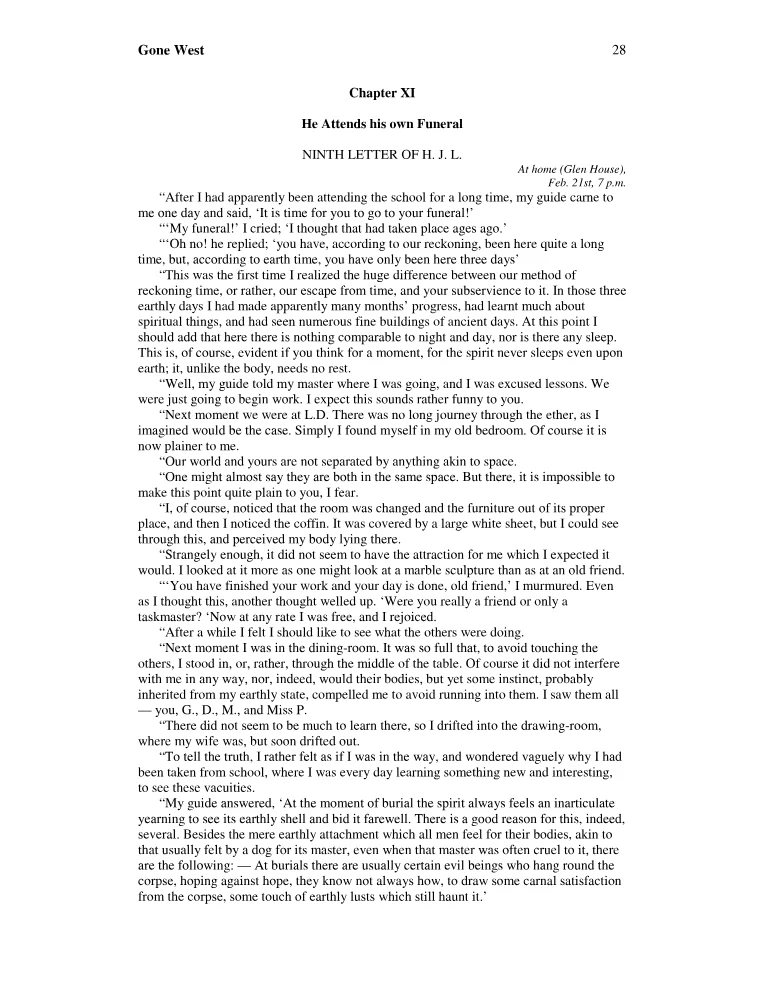
Gone West, printed p. 28, Library Reader page 41. H. J. L.’s guide announces the funeral. Geoff Cutler’s 2009 digital transcription of Ward’s 1920 text.
J. S. M. Ward, Gone West, historical text in the public domain. Geoff Cutler’s 2009 transcription expressly permits reuse for any purpose on source leaf2. This image shows the digital transcription, not an original printed facsimile. · Image source ↗ · Public Domain
A farewell and a moment of recognition
H. J. L. arrives knowing what the mourners are doing. W. A. has to work out where he is and who is in the coffin. One burial lets the narrator measure how much he has changed. The other gives him the evidence by which he recognises the change. [1][2][3]
The narrators also experience time differently. H. J. L. is surprised that only three days have passed on Earth. W. A. describes the journey as dreamlike before the burial comes into focus. The pace is part of how each story conveys what the narrator understands. [1][2][3]
Read further in the library

Gone West
Reading note
The separately titled account draws on exact passages in the consulted Library edition.
Sources
See references (4)
- Gone West, printed p. 28, Reader page 41J. S. M. Ward, Gone West: Three Narratives of After-Death Experiences, third impression, William Rider & Son, London, 1920, as reproduced in Geoff Cutler’s December 2009 digital transcription. Ward’s introduction is distinct from the supplied 1974 foreword.Read this page in Gone West ↗Return to text ↑
- Gone West, printed p. 29, Reader page 42J. S. M. Ward, Gone West: Three Narratives of After-Death Experiences, third impression, William Rider & Son, London, 1920, as reproduced in Geoff Cutler’s December 2009 digital transcription. Ward’s introduction is distinct from the supplied 1974 foreword.Read this page in Gone West ↗Return to text ↑
- Gone West, printed p. 164, Reader page 177J. S. M. Ward, Gone West: Three Narratives of After-Death Experiences, third impression, William Rider & Son, London, 1920, as reproduced in Geoff Cutler’s December 2009 digital transcription. Ward’s introduction is distinct from the supplied 1974 foreword.Read this page in Gone West ↗Return to text ↑
- Gone West, printed p. 165, Reader page 178J. S. M. Ward, Gone West: Three Narratives of After-Death Experiences, third impression, William Rider & Son, London, 1920, as reproduced in Geoff Cutler’s December 2009 digital transcription. Ward’s introduction is distinct from the supplied 1974 foreword.Read this page in Gone West ↗Return to text ↑