Atlantis: What Plato Actually Wrote
Read Plato’s Atlantis in Timaeus and Critias. Trace the war, see the ring city drawn from its stated widths, and compare Kircher and Donnelly.
In this article
Map the ring city and follow the episodes
Read the city from the centre outward, then follow the two dialogues and their later reception.
The story in order
- Sais and Solon
- Timaeus 20d–24d frames the story within a conversation.
- Beyond the Pillars
- Timaeus 24e–25a describes the island and its routes.
- The centre, rings and harbour
- Critias 113d–117e supplies the city’s dimensions.
- War and loss
- Read Timaeus 25b–d alongside the break at Critias 121c.
- 1665 and 1882
- Compare the engraving and Donnelly’s historical argument.
How Plato introduces Atlantis
In Timaeus, Critias tells a story that he says passed through his family from Solon, who heard it from an Egyptian priest at Sais. The priest describes a much older Athens. That framed account belongs to the dialogue, which presents a conversation about what a well-ordered city would do in war. [1]
The two dialogues divide the work. Timaeus gives the invasion, the resistance and the catastrophe in a short sequence. Critias returns to the rulers, institutions and city in greater detail. Reading those sections together answers why the sinking appears before Plato has described the city at length. [1][2]
See references (2)
What lies beyond the Pillars of Heracles
The story places Atlantis in front of the mouth called the Pillars of Heracles, beyond the Mediterranean opening from the speaker’s perspective. The island provides access to further islands and a landmass beyond them. Those relative positions define the imagined route. The dialogue supplies no modern coordinates. [1]
The invading power is described as having rule on both sides of the opening. The opponents who check it are the ancient Athenians celebrated by the priest. The Egyptian scene and the position of the Pillars are both part of the text’s account of how it knows the story. [1][2]
See references (2)
The city in Critias: two land belts and three sea belts
In Critias 113d–e, Poseidon makes concentric belts around the home of Cleito. There are three water belts and two dry ones, with the central island counted separately. The later rulers build bridges and cut a channel from the sea towards the outer ring. The detail explains how their harbour could work. [2]
At 116a the centre is five stades across. The first water ring is one stade wide. Going outwards, the next dry and wet rings are each two stades and the last dry and wet rings each three. Add the widths on both sides of the centre for a diameter of 27 stades across those rings. The wider city includes a wall farther out, so the figure shows the ring complex. [2]
What happens to Atlantis and Athens
The short account in Timaeus gives earthquakes and floods after the Athenian victory. The Atlantean island sinks and the Athenian fighting force is swallowed by the earth. The story also explains the mud left where the island went down. This is the account of the destruction, rather than a missing passage at the end of Critias. [1]
In Critias, the rulers lose the qualities with which they began. Zeus calls the gods together, and the dialogue as transmitted stops at the start of what he says. That abrupt ending is why readers looking for a complete war narrative in Critias have to return to the shorter account. [2][1]
See references (2)
How later readers put Atlantis on a map
Kircher’s 1665 engraving puts a named island between recognisable parts of the Old and New Worlds. Its north is at the bottom. That makes it possible to study what a seventeenth-century reader drew from the story and what he supplied himself. The engraving is a separate witness from Plato’s text. [3][1]
In 1882, Donnelly argued that Atlantis accounted for similarities between cultures across the Atlantic. Read the first chapter’s opening alongside the opening of his separate chapter on Plato. One states a nineteenth-century argument, and the other shows what use he made of the dialogue. The Reader links take you to the two exact leaves. [4][5][6][2]
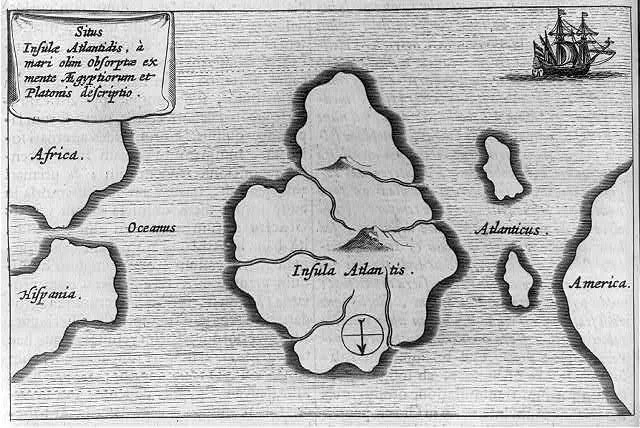
Athanasius Kircher’s imagined Atlantic island, from Mundus Subterraneus, 1665. Read its orientation and compare it with Plato’s text.
Library of Congress, Prints and Photographs Division. Digital ID cph.3b23483. · Image source ↗ · Public Domain
Read further in the library
Atlantis: The Antediluvian World
Reading note
The two opening leaves distinguish Donnelly’s thesis from his account of Plato.
Sources
See references (6)
- Plato · Timaeus 20d–26e ↗R. G. Bury’s English translation, ToposText. The report of Solon and the abbreviated story.Return to text ↑
- Plato · Critias 108e–121c ↗R. G. Bury’s English translation, ToposText. The rulers, ring city and interruption of the dialogue.Return to text ↑
- Kircher’s Atlantis engraving, 1665 ↗Library of Congress. Mundus Subterraneus, engraving, LCCN 2002698490.Return to text ↑
- Ignatius Donnelly · Atlantis: The Antediluvian World (1882) ↗Ignatius Donnelly, first published 1882, English text at Project Gutenberg.Return to text ↑
- Donnelly, Chapter I · The Purpose of the BookIgnatius Donnelly, Atlantis: The Antediluvian World, opening of Chapter I, printed p. 1. Exact Lumitheca Reader leaf.Read this page in Atlantis: The Antediluvian World ↗Return to text ↑
- Donnelly, Chapter II · Plato’s History of AtlantisIgnatius Donnelly, Atlantis: The Antediluvian World, opening of Chapter II. Exact Lumitheca Reader leaf.Read this page in Atlantis: The Antediluvian World ↗Return to text ↑