Astral phantoms
Astral phantoms are temporary forms in A Subaltern in Spirit Land. See how J. S. M. Ward distinguishes thought-made forms, borrowed coverings and empty shells.
In this article
Understanding astral phantoms
Astral phantoms are temporary forms in J. S. M. Ward’s A Subaltern in Spirit Land. A phantom can appear human or animal without containing a person or an animal soul. The guide says a thought-form can gather astral substance and gain a visible covering. [1][2][3]
Ward describes phantoms that move with passing impulses, forms supposedly sustained by someone’s vitality and forms a soul is said to use temporarily. An empty human shell is another possibility, which he distinguishes by its repetition of an old action. [3][4]
A Subaltern in Spirit Land by J. S. M. Ward
In J. S. M. Ward’s narrative, Rex first sees small fairy-like figures and then a threatening composite creature. H. J. L. explains that appearance alone does not identify the kind of being encountered. The smaller figures are attributed to children’s dreams, while the composite is described through the accidental combination of astral remnants. [1][2][4]
H. J. L. says thought-forms can attract astral atoms and acquire a temporary covering. He leaves room for other origins. What happens when the composite creature breaks apart helps him explain its instability, in contrast with the prehistoric animals he says have souls. [2]
Some phantoms allegedly prolong their existence by attaching to living people and drawing vitality. Others are taken over by a soul that has lost its former astral vehicle. The latter is said to show intelligence even while the borrowed covering continually tends to disintegrate. [3]
The guide distinguishes a shell by what it repeats. It can replay a task or scene imprinted during a human life. An unoccupied phantom is said to change with passing impulses instead. [3][4]
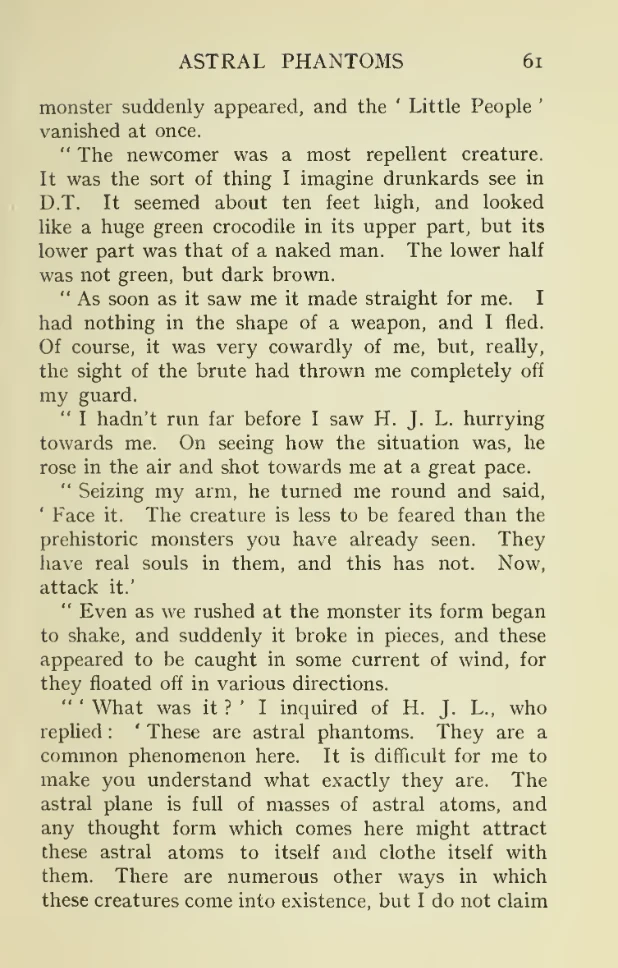
A Subaltern in Spirit Land (1920), printed p. 61, Library Reader page 76. H. J. L. explains the encounter that prompts his account of astral phantoms.
J. S. M. Ward, A Subaltern in Spirit Land. William Rider & Son, 1920. Public-domain historical text and page image, extracted from the checksum-verified retained Library scan. · Image source ↗ · Public Domain
Human Animals by Frank Hamel
Frank Hamel’s Human Animals includes artificial forms shaped through intention or strong feeling. Animal-like appearances, including threatening composite shapes, illustrate a theory of mental formation. Hamel treats these separately from the nature beings discussed through a Paracelsian classification elsewhere in his chapter. [7][8][9]
What gives a phantom its form and behaviour?
The small figures resemble fairies. When Rex later asks about Fairyland, he distinguishes forms attributed to children’s dreams from the beings he has begun to investigate there. Appearance is his starting point, and what produced the figure is the next question. [4][5][6]
Hamel and Ward both allow an animal-like figure to arise from thought or feeling. Ward also asks whether the covering belongs to anyone, what gives it continuity and whether it carries a habit from a former life. These questions give the same-looking figures different histories. [2][3][4][7][8][9]
See references (8)
- A Subaltern in Spirit Land, printed p. 61, Reader page 76
- A Subaltern in Spirit Land, printed p. 62, Reader page 77
- A Subaltern in Spirit Land, printed p. 63, Reader page 78
- A Subaltern in Spirit Land, printed p. 259, Reader page 274
- A Subaltern in Spirit Land, printed p. 260, Reader page 275
- Human Animals, printed p. 271, Reader page 280
- Human Animals, printed p. 272, Reader page 281
- Human Animals, printed p. 273, Reader page 282
Read further in the library
A Subaltern in Spirit Land: A Sequel to Gone West
Reading note
The separately titled account draws on exact passages in the consulted Library edition.
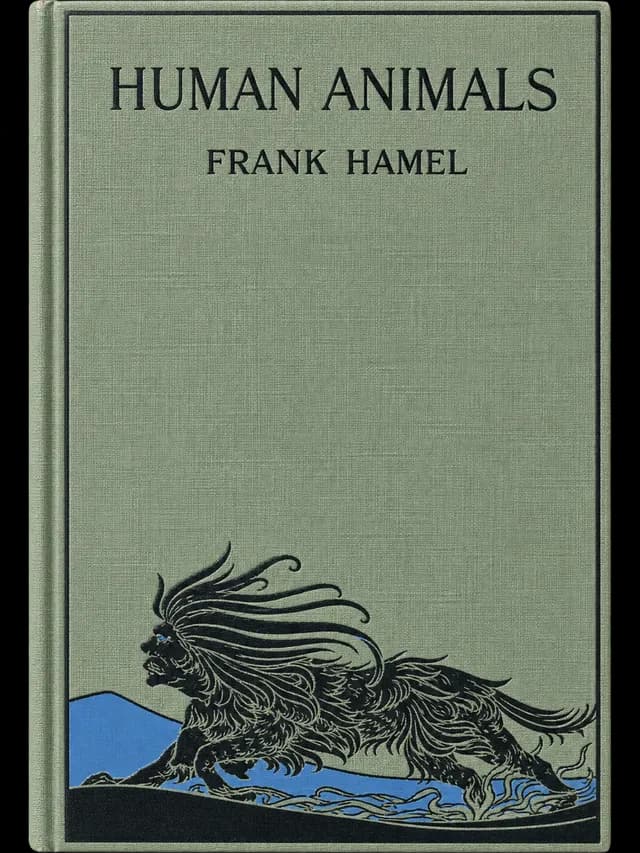
Human Animals
Reading note
Separately attributed comparison with exact previously researched Library passages.
Sources
See references (9)
- A Subaltern in Spirit Land, printed p. 60, Reader page 75J. S. M. Ward, A Subaltern in Spirit Land: A Sequel to Gone West. William Rider & Son, London, 1920. Narrated experiences and explanations are attributed to Ward and his reported spirit contributors, especially his brother Rex (R. L. W.) and H. J. L.Read this page in A Subaltern in Spirit Land: A Sequel to Gone West ↗Return to text ↑
- A Subaltern in Spirit Land, printed p. 61, Reader page 76J. S. M. Ward, A Subaltern in Spirit Land: A Sequel to Gone West. William Rider & Son, London, 1920. Narrated experiences and explanations are attributed to Ward and his reported spirit contributors, especially his brother Rex (R. L. W.) and H. J. L.Read this page in A Subaltern in Spirit Land: A Sequel to Gone West ↗Return to text ↑
- A Subaltern in Spirit Land, printed p. 62, Reader page 77J. S. M. Ward, A Subaltern in Spirit Land: A Sequel to Gone West. William Rider & Son, London, 1920. Narrated experiences and explanations are attributed to Ward and his reported spirit contributors, especially his brother Rex (R. L. W.) and H. J. L.Read this page in A Subaltern in Spirit Land: A Sequel to Gone West ↗Return to text ↑
- A Subaltern in Spirit Land, printed p. 63, Reader page 78J. S. M. Ward, A Subaltern in Spirit Land: A Sequel to Gone West. William Rider & Son, London, 1920. Narrated experiences and explanations are attributed to Ward and his reported spirit contributors, especially his brother Rex (R. L. W.) and H. J. L.Read this page in A Subaltern in Spirit Land: A Sequel to Gone West ↗Return to text ↑
- A Subaltern in Spirit Land, printed p. 259, Reader page 274J. S. M. Ward, A Subaltern in Spirit Land: A Sequel to Gone West. William Rider & Son, London, 1920. Narrated experiences and explanations are attributed to Ward and his reported spirit contributors, especially his brother Rex (R. L. W.) and H. J. L.Read this page in A Subaltern in Spirit Land: A Sequel to Gone West ↗Return to text ↑
- A Subaltern in Spirit Land, printed p. 260, Reader page 275J. S. M. Ward, A Subaltern in Spirit Land: A Sequel to Gone West. William Rider & Son, London, 1920. Narrated experiences and explanations are attributed to Ward and his reported spirit contributors, especially his brother Rex (R. L. W.) and H. J. L.Read this page in A Subaltern in Spirit Land: A Sequel to Gone West ↗Return to text ↑
- Human Animals, printed p. 271, Reader page 280Frank Hamel, Human Animals. Frederick A. Stokes Co., New York, undated title page; preface dated London, 1915. Exact printed pages refer to the retained Library scan.Read this page in Human Animals ↗Return to text ↑
- Human Animals, printed p. 272, Reader page 281Frank Hamel, Human Animals. Frederick A. Stokes Co., New York, undated title page; preface dated London, 1915. Exact printed pages refer to the retained Library scan.Read this page in Human Animals ↗Return to text ↑
- Human Animals, printed p. 273, Reader page 282Frank Hamel, Human Animals. Frederick A. Stokes Co., New York, undated title page; preface dated London, 1915. Exact printed pages refer to the retained Library scan.Read this page in Human Animals ↗Return to text ↑