Astral memory and waking memory
Astral memory is recall attributed to an astral experience. Compare the dreamer Carrie in J. S. M. Ward’s Gone West with Celestion’s enduring soul-mind.
In this article
Understanding astral memory and waking memory
Astral memory is what a person is said to remember while having an astral experience. Some Spiritualist writers describe experiences that are clear in one state and only fragmentary on waking. [1][2][3][4]
The distinction leaves two questions. What could the traveller remember while asleep, and what do they think happened when they awake? The same encounter can look like an ordinary memory from one side and a dream from the other. [2]
Gone West by J. S. M. Ward
J. S. M. Ward’s Gone West describes a crowd of living dreamers visiting the astral plane. Some appear only partly aware; others arrive looking for particular people. H. J. L., Ward’s reported spirit guide, says that many maintain a regular life there, interrupted by what they experience as sleep when they return to physical waking. [1][2]
According to the guide, the astral memory generally retains more than the physical memory. Yet some visitors allegedly remember their earthly lives so poorly during these experiences that they imagine they live only in the astral world. This produces an unusual explanation for failing to notice death: the visitor may simply stop returning to bodily waking. [2]
The meeting with Carrie makes the claimed discontinuity concrete. She recognises H. J. L. but initially cannot remember communications received on earth through Ward. He describes her as still half asleep. Their conversation then takes place within a house whose astral form is said to have survived its destruction. [2][3]
When Carrie says she wants to go to bed, H. J. L. takes her tiredness as a call back to her physical body. Ward adds that she later remembered much of the meeting but thought she had dreamed it. Her recollection is part of Ward’s account, and her explanation differs from the guide’s. [3][4]
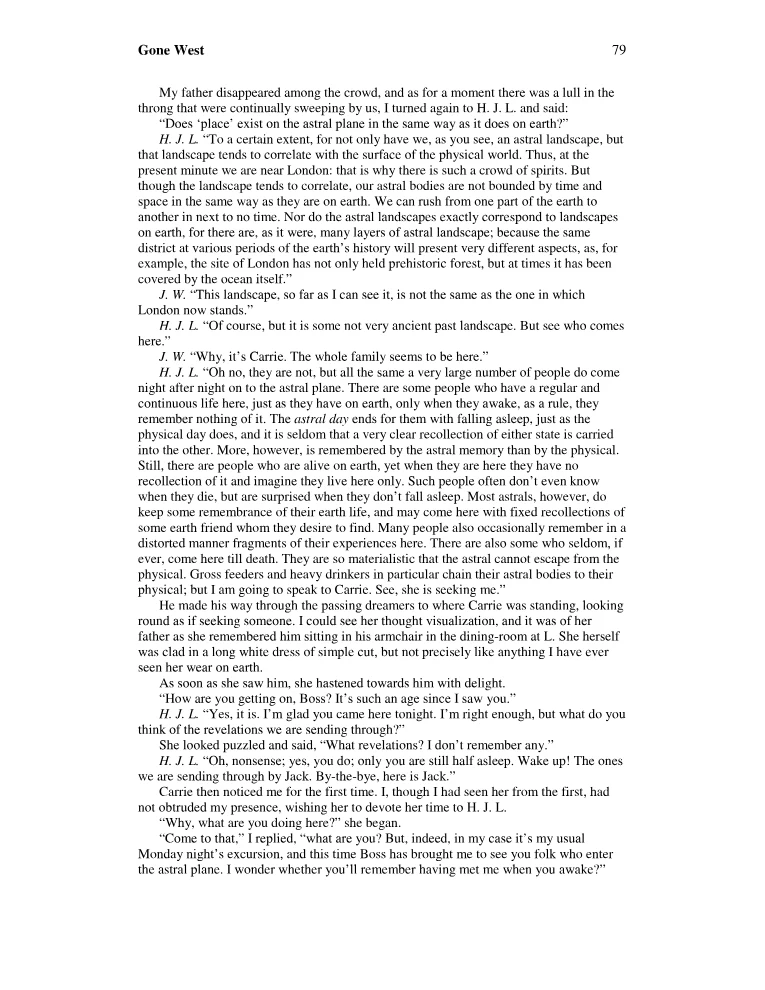
Gone West, printed p. 79, Library Reader page 92. Ward prepares for the encounter with Carrie. This page is from Geoff Cutler’s 2009 digital transcription of the 1920 text.
J. S. M. Ward, Gone West, historical text in the public domain. Geoff Cutler’s 2009 transcription expressly permits reuse for any purpose on source leaf2. This image shows the digital transcription, not an original printed facsimile. · Image source ↗ · Public Domain
The Angels’ Diary and Celestion Study of Man
The volume attributes the material to Effie M. Shirey and Charles Samson as spirit communications, with Elizabeth Maud Weatherhead credited as the medium. Celestion Study of Man calls the deepest impressions part of an enduring subconscious mind. A strongly felt memory is said to stay with that mind, which accompanies the astral form during sleep. [5][6][7]
Keeping a memory and being able to recall it
Ward asks when someone can recall an experience and what they call it afterwards. Celestion asks what remains of an experience when ordinary awareness has changed. An enduring impression and a memory someone can retrieve at will are different claims. [1][2][4][5][6][3]
Ward also distinguishes the thought-image of a desired person from the person said to arrive. A mother pictures her child before the child’s astral form appears. For Ward, a vivid impression can occur even when the person it represents is absent. [1]
See references (6)
Read further in the library

Gone West
Reading note
The separately titled account draws on exact passages in the consulted Library edition.
The Angels’ Diary and Celestion Study of Man
Reading note
Separately attributed comparison with exact previously researched Library passages.
Sources
See references (7)
- Gone West, printed p. 78, Reader page 91J. S. M. Ward, Gone West: Three Narratives of After-Death Experiences, third impression, William Rider & Son, London, 1920, as reproduced in Geoff Cutler’s December 2009 digital transcription. Ward’s introduction is distinct from the supplied 1974 foreword.Read this page in Gone West ↗Return to text ↑
- Gone West, printed p. 79, Reader page 92J. S. M. Ward, Gone West: Three Narratives of After-Death Experiences, third impression, William Rider & Son, London, 1920, as reproduced in Geoff Cutler’s December 2009 digital transcription. Ward’s introduction is distinct from the supplied 1974 foreword.Read this page in Gone West ↗Return to text ↑
- Gone West, printed p. 80, Reader page 93J. S. M. Ward, Gone West: Three Narratives of After-Death Experiences, third impression, William Rider & Son, London, 1920, as reproduced in Geoff Cutler’s December 2009 digital transcription. Ward’s introduction is distinct from the supplied 1974 foreword.Read this page in Gone West ↗Return to text ↑
- Gone West, printed p. 81, Reader page 94J. S. M. Ward, Gone West: Three Narratives of After-Death Experiences, third impression, William Rider & Son, London, 1920, as reproduced in Geoff Cutler’s December 2009 digital transcription. Ward’s introduction is distinct from the supplied 1974 foreword.Read this page in Gone West ↗Return to text ↑
- The Angels’ Diary and Celestion Study of Man, Reader page 126Effie M. Shirey and Charles Samson, The Angels’ Diary and Celestion Study of Man (1903), communicated through Elizabeth Maud Weatherhead according to the volume’s acknowledgment. Accounts below refer to the exact retained Library edition IMJ-0055-E001.Read this page in The Angels’ Diary and Celestion Study of Man ↗Return to text ↑
- The Angels’ Diary and Celestion Study of Man, Reader page 127Effie M. Shirey and Charles Samson, The Angels’ Diary and Celestion Study of Man (1903), communicated through Elizabeth Maud Weatherhead according to the volume’s acknowledgment. Accounts below refer to the exact retained Library edition IMJ-0055-E001.Read this page in The Angels’ Diary and Celestion Study of Man ↗Return to text ↑
- The Angels’ Diary and Celestion Study of Man, Denver, 1903 ↗Library of Congress catalogue and preface note.Return to text ↑