Historical layers of astral landscapes
J. S. M. Ward describes different eras of one place as layers of an astral landscape. Compare destroyed houses, older buildings and other surviving forms.
In this article
Understanding historical layers of astral landscapes
In J. S. M. Ward’s books, an astral landscape can hold different past appearances of a place. A traveller near London might see how the district looked in another period, with different buildings or a different landscape altogether. [1]
Ward distinguishes a landscape’s layers from astral remnants of particular objects. A destroyed house, a surviving chess piece and a building deliberately made from thought have different sources and different conditions for remaining visible. [2][3][1][4][9][5]
Gone West by J. S. M. Ward
J. S. M. Ward’s Gone West locates one gathering of living dreamers near London, while the landscape differs from contemporary London. H. J. L. explains that the same district can have many astral layers corresponding to different periods. Forest and even an earlier sea provide examples of environments no longer present on the physical surface. [1]
Ward and Carrie enter what the guide takes to be a Georgian house. Gaps on the walls and the remaining furniture lead H. J. L. to suspect the earthly house was destroyed, possibly by fire. He says the astral form of an object ordinarily fades unless its connection with a person sustains it. [4]
An earlier excursion concerns the spirit plane rather than this astral setting. There H. J. L. joins people interested in architecture and visits the forms of buildings that have been destroyed or altered. Successive forms of the Tower of London can supposedly be examined, while its unchanged present form is absent. [2]
The later art discussion supplies another distinction. Ancient objects can be restored to their original uses and settings, while an artist can also construct a new building from mind-stuff. A historical survival and a deliberately created work may stand within the same wider spiritual world without being the same kind of object. [3][5]
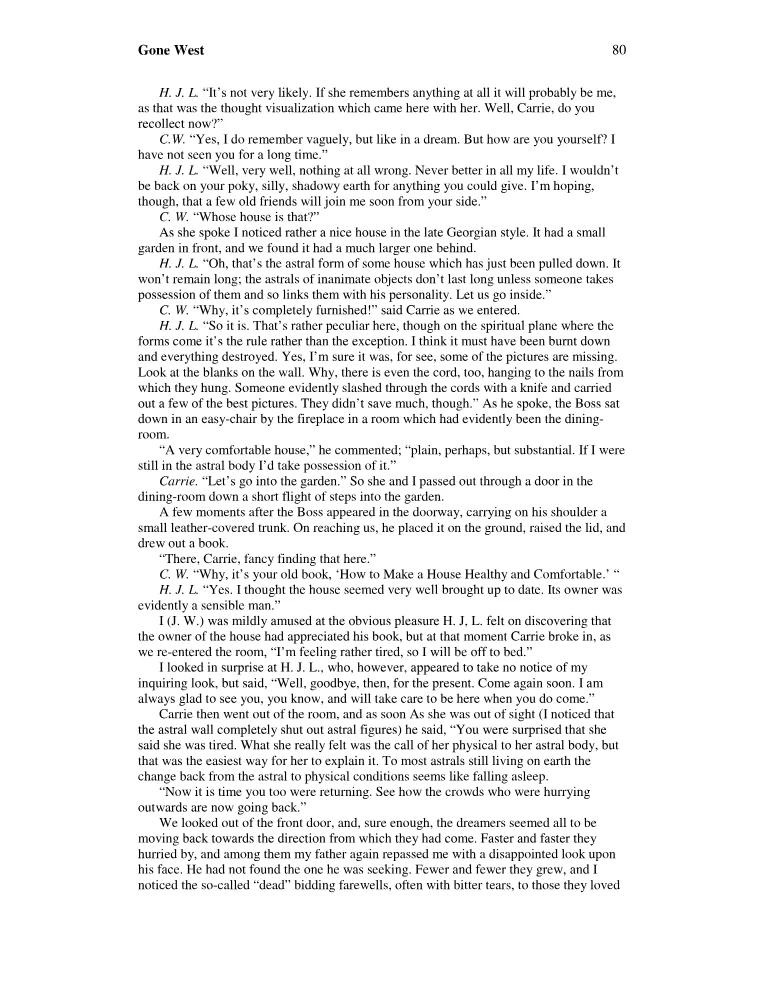
Gone West, printed p. 80, Library Reader page 93. The missing pictures and remaining cords help H. J. L. interpret the house. Geoff Cutler’s digital transcription.
J. S. M. Ward, Gone West, historical text in the public domain. Geoff Cutler’s 2009 transcription expressly permits reuse for any purpose on source leaf2. This image shows the digital transcription, not an original printed facsimile. · Image source ↗ · Public Domain
A Subaltern in Spirit Land by J. S. M. Ward
In A Subaltern in Spirit Land, J. S. M. Ward distinguishes the temporary astral counterpart of a destroyed building from a more enduring spiritual form. The astral building is said to persist while people on that plane still recognise it. The discussion of Westminster Abbey gives the more enduring forms a concrete example. [6][7][8]
The sequel extends surviving forms beyond buildings. In Ward’s account of an astral curio shop, destroyed ivory objects gather among similar objects. A set of chessmen may remain incomplete because the other pieces still exist on earth. The apparently surviving object therefore need not be a newly created thought-form. [9]
The guide’s discussion of paper offerings supplies a further distinction. A paper model is said to have the astral form of that paper object, rather than automatically becoming the full-sized article it represents. Ward’s contributors separate the physical source object, its intention and the kind of form supposedly surviving it. [10][11]
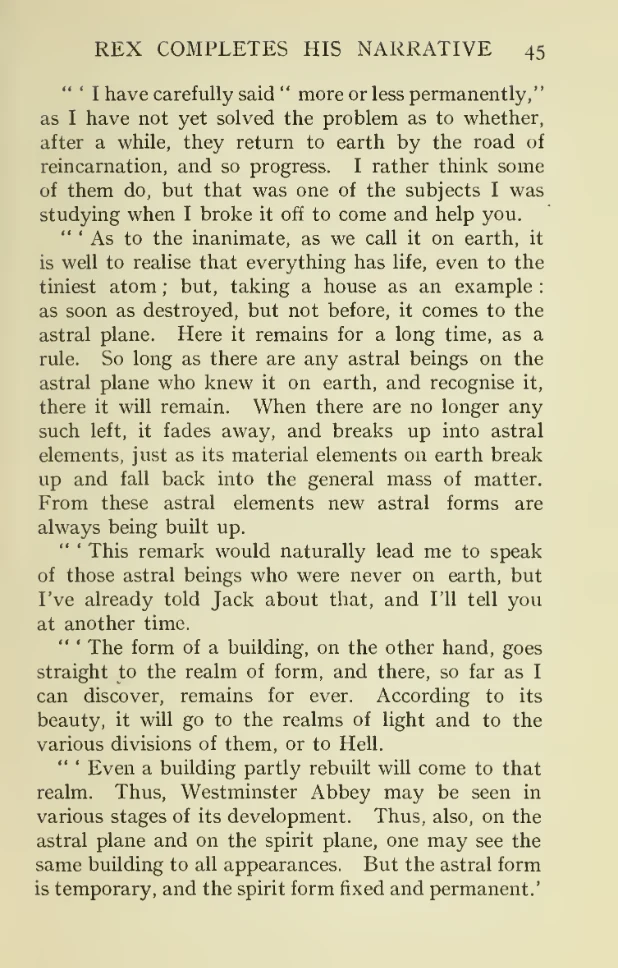
Source facsimile: A Subaltern in Spirit Land (1920), printed p. 45, Reader page 60.
J. S. M. Ward, A Subaltern in Spirit Land. William Rider & Son, 1920. Public-domain historical text and page image, extracted from the checksum-verified retained Library scan. · Image source ↗ · Public Domain
See references (6)
- A Subaltern in Spirit Land, printed p. 43, Reader page 58
- A Subaltern in Spirit Land, printed p. 44, Reader page 59
- A Subaltern in Spirit Land, printed p. 45, Reader page 60
- A Subaltern in Spirit Land, printed p. 75, Reader page 90
- A Subaltern in Spirit Land, printed p. 76, Reader page 91
- A Subaltern in Spirit Land, printed p. 77, Reader page 92
What survives, and for how long?
“Memory of place” is a way of describing these stories. Ward explains persistence differently according to the world and the object. Seeing a house full of historical detail makes it recognisable within the story. The guide still has to infer what happened to the earthly building. [2][1][4]
Gone West asks how different eras of one place can remain visible. The sequel asks how long a remembered form persists and which pieces survive. Both are Ward’s narratives, and the later one takes up distinctions the earlier book had already introduced. [6][7][8][2][1][4]
The incomplete chess set makes the difference precise. The surviving collection can contain the pieces that were destroyed on Earth. A piece still in earthly use has a different history, even if it belonged to the same set. [12][9][10][11]
Ward’s paper example gives material history another consequence. A paper model leaves the form of that particular object. Its intention as a gift or representation does not turn it into the full-sized object it depicts. [2][1][4][12][9][10][11]
See references (10)
- Gone West, printed p. 79, Reader page 92
- Gone West, printed p. 26, Reader page 39
- Gone West, printed p. 80, Reader page 93
- A Subaltern in Spirit Land, printed p. 43, Reader page 58
- A Subaltern in Spirit Land, printed p. 44, Reader page 59
- A Subaltern in Spirit Land, printed p. 45, Reader page 60
- A Subaltern in Spirit Land, printed p. 75, Reader page 90
- A Subaltern in Spirit Land, printed p. 76, Reader page 91
- A Subaltern in Spirit Land, printed p. 77, Reader page 92
- A Subaltern in Spirit Land, printed p. 45, Reader page 60
Read further in the library

Gone West
Reading note
The separately titled account draws on exact passages in the consulted Library edition.
A Subaltern in Spirit Land: A Sequel to Gone West
Reading note
Separately attributed comparison with exact previously researched Library passages.
Sources
See references (12)
- Gone West, printed p. 79, Reader page 92J. S. M. Ward, Gone West: Three Narratives of After-Death Experiences, third impression, William Rider & Son, London, 1920, as reproduced in Geoff Cutler’s December 2009 digital transcription. Ward’s introduction is distinct from the supplied 1974 foreword.Read this page in Gone West ↗Return to text ↑
- Gone West, printed p. 26, Reader page 39J. S. M. Ward, Gone West: Three Narratives of After-Death Experiences, third impression, William Rider & Son, London, 1920, as reproduced in Geoff Cutler’s December 2009 digital transcription. Ward’s introduction is distinct from the supplied 1974 foreword.Read this page in Gone West ↗Return to text ↑
- Gone West, printed p. 56, Reader page 69J. S. M. Ward, Gone West: Three Narratives of After-Death Experiences, third impression, William Rider & Son, London, 1920, as reproduced in Geoff Cutler’s December 2009 digital transcription. Ward’s introduction is distinct from the supplied 1974 foreword.Read this page in Gone West ↗Return to text ↑
- Gone West, printed p. 80, Reader page 93J. S. M. Ward, Gone West: Three Narratives of After-Death Experiences, third impression, William Rider & Son, London, 1920, as reproduced in Geoff Cutler’s December 2009 digital transcription. Ward’s introduction is distinct from the supplied 1974 foreword.Read this page in Gone West ↗Return to text ↑
- Gone West, printed p. 57, Reader page 70J. S. M. Ward, Gone West: Three Narratives of After-Death Experiences, third impression, William Rider & Son, London, 1920, as reproduced in Geoff Cutler’s December 2009 digital transcription. Ward’s introduction is distinct from the supplied 1974 foreword.Read this page in Gone West ↗Return to text ↑
- A Subaltern in Spirit Land, printed p. 43, Reader page 58A Subaltern in Spirit Land by J. S. M. Ward. Exact previously researched Library reference retained.Read this page in A Subaltern in Spirit Land: A Sequel to Gone West ↗Return to text ↑
- A Subaltern in Spirit Land, printed p. 44, Reader page 59A Subaltern in Spirit Land by J. S. M. Ward. Exact previously researched Library reference retained.Read this page in A Subaltern in Spirit Land: A Sequel to Gone West ↗Return to text ↑
- A Subaltern in Spirit Land, printed p. 45, Reader page 60A Subaltern in Spirit Land by J. S. M. Ward. Exact previously researched Library reference retained.Read this page in A Subaltern in Spirit Land: A Sequel to Gone West ↗Return to text ↑
- A Subaltern in Spirit Land, printed p. 75, Reader page 90J. S. M. Ward, A Subaltern in Spirit Land: A Sequel to Gone West. William Rider & Son, London, 1920. Narrated experiences and explanations are attributed to Ward and his reported spirit contributors, especially his brother Rex (R. L. W.) and H. J. L.Read this page in A Subaltern in Spirit Land: A Sequel to Gone West ↗Return to text ↑
- A Subaltern in Spirit Land, printed p. 76, Reader page 91J. S. M. Ward, A Subaltern in Spirit Land: A Sequel to Gone West. William Rider & Son, London, 1920. Narrated experiences and explanations are attributed to Ward and his reported spirit contributors, especially his brother Rex (R. L. W.) and H. J. L.Read this page in A Subaltern in Spirit Land: A Sequel to Gone West ↗Return to text ↑
- A Subaltern in Spirit Land, printed p. 77, Reader page 92J. S. M. Ward, A Subaltern in Spirit Land: A Sequel to Gone West. William Rider & Son, London, 1920. Narrated experiences and explanations are attributed to Ward and his reported spirit contributors, especially his brother Rex (R. L. W.) and H. J. L.Read this page in A Subaltern in Spirit Land: A Sequel to Gone West ↗Return to text ↑
- A Subaltern in Spirit Land, printed p. 45, Reader page 60J. S. M. Ward, A Subaltern in Spirit Land: A Sequel to Gone West. William Rider & Son, London, 1920. Narrated experiences and explanations are attributed to Ward and his reported spirit contributors, especially his brother Rex (R. L. W.) and H. J. L.Read this page in A Subaltern in Spirit Land: A Sequel to Gone West ↗Return to text ↑