Astral Atmospheres
Astral atmospheres are the qualities Steiner says distinguish places in clairvoyant perception. Compare his examples with Swedenborg’s spheres of affection.
In this article
Understanding the concept
Astral atmospheres are the spiritual qualities Rudolf Steiner says a person can perceive around a place through clairvoyance. His examples move from a hospital and a ballroom to towns organised around commerce or study. [1][2]
The idea extends the visibility he gives to individual wishes and feelings. At the scale of a place, the question becomes what qualities are present when many people act within the same surroundings. [3][1][2]
Initiation and Its Results by Rudolf Steiner
Rudolf Steiner’s Initiation and Its Results moves from the forces behind a crystal or plant to the wishes and passions expressed around people and animals. These are described as acquiring form and colour in an astral environment. The individual’s aura supplies one scale of the account. [3][1]
Steiner says the atmosphere of a hospital differs from a ballroom’s and that a commercial town differs from a university town. The examples show a change of scale, from the qualities around one being to those he associates with a shared place. [1][2]
The book describes the first impressions as weak and dreamlike. They become clearer as the learner supposedly grows more awake to their surroundings on that plane. [2]
The following discussion distinguishes qualities of action and desire. A loving act and an act of hatred produce different images, while attachment becomes more powerful after death when physical satisfaction is absent. The atmosphere passage belongs to this wider moral and afterlife theory rather than to a separate science of places. [2][4]
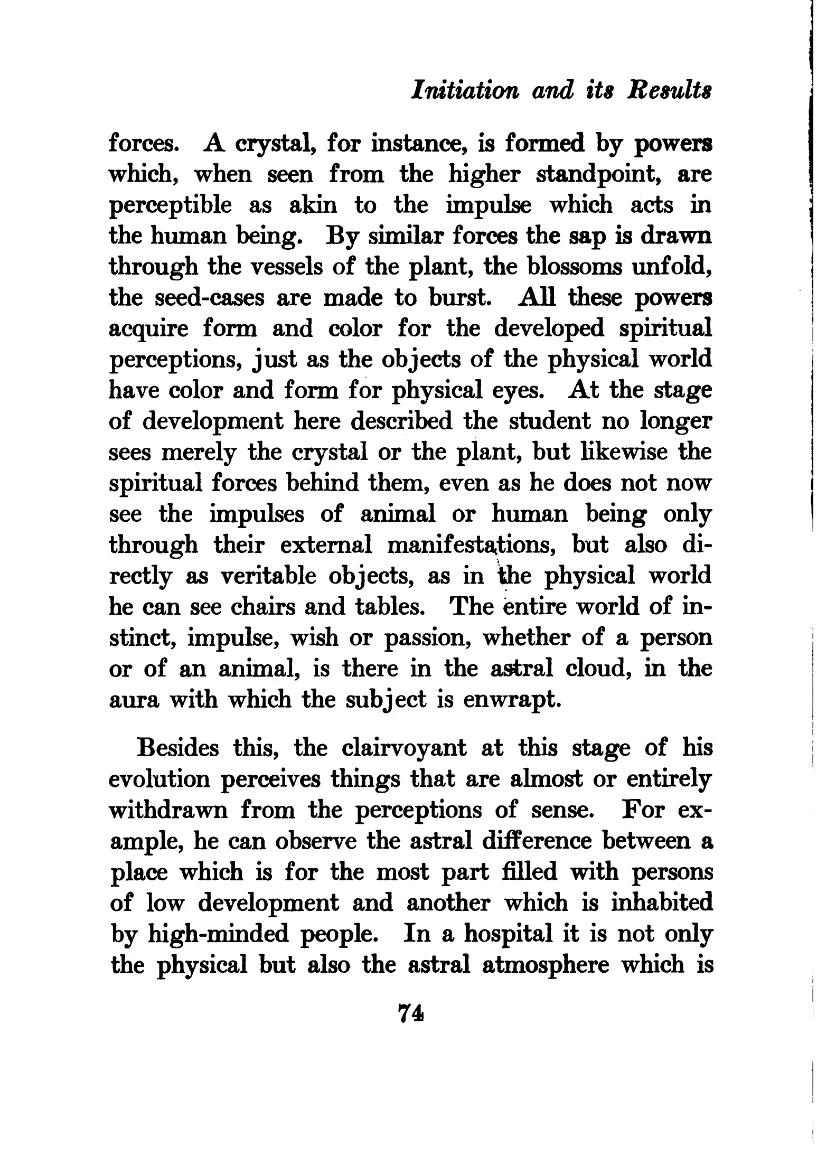
Initiation and Its Results (1909), printed p. 74, Library Reader page 72. The account moves from the aura of an individual to the atmosphere of a place.
Rudolf Steiner, Initiation and Its Results, Clifford Bax translation, First American Edition, 1909. Public-domain historical page from the checksum-verified Library PDF. · Image source ↗ · Public Domain
Heaven and Its Wonders and Hell by Emanuel Swedenborg
Emanuel Swedenborg describes spheres flowing from the loves and thoughts of individuals and societies. They communicate shared life and can convey a sense of joy whose reception depends on the other person’s capacity. Their extension is part of his explanation of spiritual association. [5][6][7][8]
What is shared across a place
Steiner uses familiar places so that the contrast comes from the additional field the observer claims to sense. The people still carry on the activities that make the hospital, ballroom or town recognisable. [1][2]
In Swedenborg, a sphere of affection brings the qualities of a person or society into contact with others. Steiner asks how an observer would sense a difference between places. The two accounts give a shared environment different work to do. [5][6][7][8][3][1][2][4]
See references (8)
- Initiation and Its Results, printed p. 74, Reader page 72
- Initiation and Its Results, printed p. 75, Reader page 73
- Initiation and Its Results, Reader page 71
- Initiation and Its Results, printed p. 76, Reader page 74
- Heaven and Its Wonders and Hell, printed p. 34, Reader page 41
- Heaven and Its Wonders and Hell, printed p. 35, Reader page 42
- Heaven and Its Wonders and Hell, printed p. 350, Reader page 357
- Heaven and Its Wonders and Hell, printed p. 562, Reader page 569
Read further in the library

Initiation and Its Results
Reading note
The separately titled account draws on exact passages in the consulted Library edition.

Heaven and Its Wonders and Hell
Reading note
Separately attributed comparison with exact previously researched Library passages.
Sources
See references (8)
- Initiation and Its Results, printed p. 74, Reader page 72Rudolf Steiner, Initiation and Its Results: A Sequel to The Way of Initiation, translated by Clifford Bax. First American Edition, 1909. Macoy Publishing and Masonic Supply Co., New York; Max Gysi, London. Claims of clairvoyant perception and subtle organs remain attributed. References identify the exact consulted Library edition.Read this page in Initiation and Its Results ↗Return to text ↑
- Initiation and Its Results, printed p. 75, Reader page 73Rudolf Steiner, Initiation and Its Results: A Sequel to The Way of Initiation, translated by Clifford Bax. First American Edition, 1909. Macoy Publishing and Masonic Supply Co., New York; Max Gysi, London. Claims of clairvoyant perception and subtle organs remain attributed. References identify the exact consulted Library edition.Read this page in Initiation and Its Results ↗Return to text ↑
- Initiation and Its Results, Reader page 71Rudolf Steiner, Initiation and Its Results: A Sequel to The Way of Initiation, translated by Clifford Bax. First American Edition, 1909. Macoy Publishing and Masonic Supply Co., New York; Max Gysi, London. Claims of clairvoyant perception and subtle organs remain attributed. References identify the exact consulted Library edition.Read this page in Initiation and Its Results ↗Return to text ↑
- Initiation and Its Results, printed p. 76, Reader page 74Rudolf Steiner, Initiation and Its Results: A Sequel to The Way of Initiation, translated by Clifford Bax. First American Edition, 1909. Macoy Publishing and Masonic Supply Co., New York; Max Gysi, London. Claims of clairvoyant perception and subtle organs remain attributed. References identify the exact consulted Library edition.Read this page in Initiation and Its Results ↗Return to text ↑
- Heaven and Its Wonders and Hell, printed p. 34, Reader page 41Emanuel Swedenborg, Heaven and Its Wonders and Hell, From Things Heard and Seen, translated by J. C. Ager. American Swedenborg Printing and Publishing Society, New York, 1916. Latin original first published in 1758. Numbered sections and exact pages refer to this consulted edition. Claims of spiritual experience remain attributed.Read this page in Heaven and Its Wonders and Hell ↗Return to text ↑
- Heaven and Its Wonders and Hell, printed p. 35, Reader page 42Emanuel Swedenborg, Heaven and Its Wonders and Hell, From Things Heard and Seen, translated by J. C. Ager. American Swedenborg Printing and Publishing Society, New York, 1916. Latin original first published in 1758. Numbered sections and exact pages refer to this consulted edition. Claims of spiritual experience remain attributed.Read this page in Heaven and Its Wonders and Hell ↗Return to text ↑
- Heaven and Its Wonders and Hell, printed p. 350, Reader page 357Emanuel Swedenborg, Heaven and Its Wonders and Hell, From Things Heard and Seen, translated by J. C. Ager. American Swedenborg Printing and Publishing Society, New York, 1916. Latin original first published in 1758. Numbered sections and exact pages refer to this consulted edition. Claims of spiritual experience remain attributed.Read this page in Heaven and Its Wonders and Hell ↗Return to text ↑
- Heaven and Its Wonders and Hell, printed p. 562, Reader page 569Emanuel Swedenborg, Heaven and Its Wonders and Hell, From Things Heard and Seen, translated by J. C. Ager. American Swedenborg Printing and Publishing Society, New York, 1916. Latin original first published in 1758. Numbered sections and exact pages refer to this consulted edition. Claims of spiritual experience remain attributed.Read this page in Heaven and Its Wonders and Hell ↗Return to text ↑