Aranyani
Aranyani is the forest goddess of Rigveda 10.146. Read how its insects, unseen voices and untended food give the woods a presence of their own.
In this article
Who is Aranyani?
Aranyani is the goddess of wild places and forests addressed in Rigveda 10.146. The hymn listens for her among insects, calls and the noises of work that seem to arise in an evening wood. It ends by praising a forest that feeds its inhabitants without being tilled. [1][3][4]
The forest queen in Rigveda 10.146
In Ralph T. H. Griffith’s translation, the speaker asks why the goddess avoids the village. The calls of a grasshopper and cicada mingle with noises that seem to come from cattle, carts and woodcutters. A person eats fruit and rests. The hymn closes by praising Aranyani as the fragrant mother of woodland life. [1]
Indian Myth and Legend by Donald A. Mackenzie
In Indian Myth and Legend, Donald A. Mackenzie calls Aranyani a forest nymph and places her among beings of wild places. In his excerpt, forest sounds give the impression of a person calling a cow, carts moving and wood being cut. He reads the voices as echoes. [3][4]
Mackenzie’s goddess leaves alone those who keep out of her dwelling. In his rendering she then eats fruit and goes to rest. From this short passage he moves to a broader discussion of birds and spirits. [4]
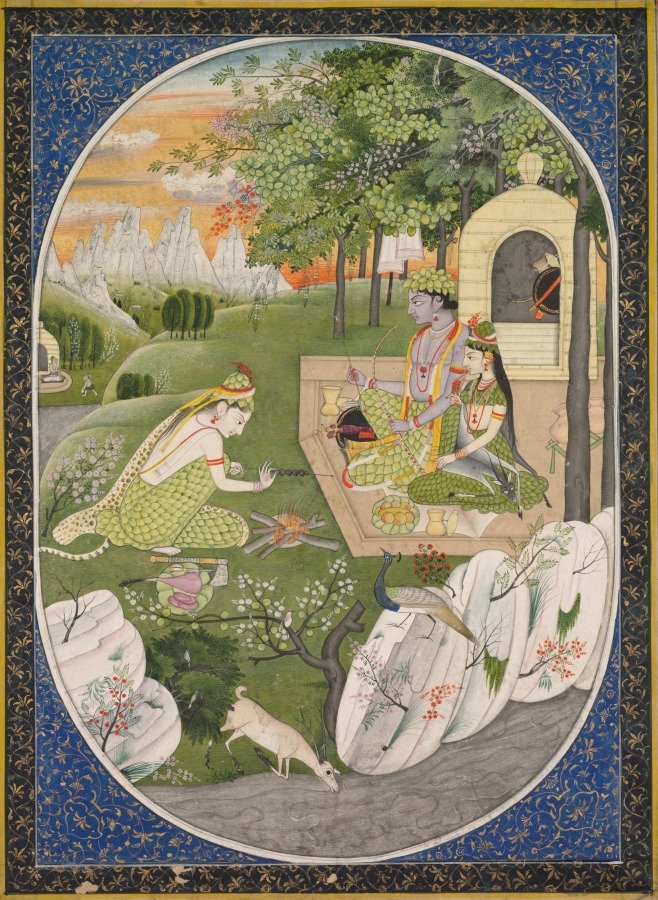
Rama, Sita and Lakshmana in a forest, around 1830. This painting comes from the Ramayana and offers another view of the forest in Indian art.
Cleveland Museum of Art, Bequest of Mrs. Severance A. Millikin, 1989.332. CC0; resized and converted to JPEG. · Image source ↗ · CC0
Who eats the forest’s fruit?
In Griffith’s version it is the person in the forest who eats and rests. Mackenzie gives both actions to the goddess. That small change shifts attention from what the forest gives its visitors to how Aranyani lives in her own dwelling. [3][4][1]
Read further in the library
Indian Myth and Legend
Reading note
The separately titled account draws on exact passages in the consulted Library edition.
Sources
See references (4)
- Rigveda 10.146, translated by Ralph T. H. Griffith ↗Complete six-verse hymn directly read. Griffith’s subjects and wording remain distinct from the short verse rendering embedded in Mackenzie.Return to text ↑
- Rama, Sita, and Lakshmana in the forest, c. 1830 ↗Cleveland Museum of Art, Bequest of Mrs. Severance A. Millikin, 1989.332. CC0; resized and converted to JPEG.
- Indian Myth and Legend, Reader page 141Donald A. Mackenzie, Indian Myth and Legend, Gresham Publishing Company Limited, London, undated consulted impression. Library edition IMJ-0649-E001. Persistent PageIDs and current Reader positions verified against the supplied PDF and cached Reader manifest. Embedded translations are Mackenzie’s presentation unless a separately consulted primary text is named.Read this page in Indian Myth and Legend ↗Return to text ↑
- Indian Myth and Legend, Reader page 142Donald A. Mackenzie, Indian Myth and Legend, Gresham Publishing Company Limited, London, undated consulted impression. Library edition IMJ-0649-E001. Persistent PageIDs and current Reader positions verified against the supplied PDF and cached Reader manifest. Embedded translations are Mackenzie’s presentation unless a separately consulted primary text is named.Read this page in Indian Myth and Legend ↗Return to text ↑