Apparitions
An apparition is a reported appearance of someone or something believed absent. Explore recognition, dreams and the way eyewitness stories reach the record.
In this article
What is an apparition?
An apparition is a reported appearance of a person or figure believed to be absent. It may look solid, like a familiar person in a room, or seem indistinct, like a shape taking form in dim light. The word describes an appearance as it was experienced or remembered. [2][3][4][5][6][7][8]
The person apparently seen can be living or dead. Leadbeater’s Theosophical account gives the same recognisable likeness several possible explanations. His examples bring out a question shared by very different accounts: does recognising a face also identify the cause of the experience? [13]
An appearance may be taken as a warning or a message. A haunting usually implies some continuing association with a place. One silent encounter can be described in its own terms before a witness or collector gives it a wider meaning. [3][4][5][6][7][8]
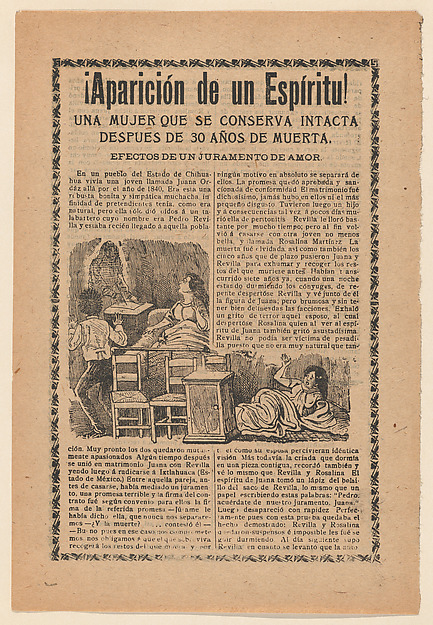
A broadside illustrated by José Guadalupe Posada, about 1900–1913. Words and pictures turn a reported appearance into a story for public circulation.
The Metropolitan Museum of Art, The Elisha Whittelsey Collection, The Elisha Whittelsey Fund, 1946; 46.46.187. Public Domain. · Image source ↗ · Public Domain
The Other World, edited by Frederick George Lee
Frederick George Lee’s The Other World collects stories from letters, contributors and earlier books. In some cases papers were lost or details came through another person. The uncertainty survives alongside the vivid account of what was seen. [2][9][10][3][4]
The Chester-le-Street narrative tells of a miller encountering a bloodied woman who identifies herself as a murder victim. She gives information about the disposal of her body and demands that he reveal it. The account says a search subsequently finds the body and other evidence. Within the narrative, the apparition has a purpose: bringing a concealed wrong before earthly authority. [11][12][9]
The testimony has limits of its own. The narrator, William Lumley, acknowledges the loss of his notes and a copied letter, uncertainty about some circumstances, and the absence of certainty concerning an additional reported appearance to a judge or juror. Lee takes the story from Robert Surtees’s History of Durham. That chain should not be flattened into Lee personally witnessing either the apparition or the trial. [2][9][10]
The Sherbroke and Wynyard material shows another kind of layered report. Lee includes a discussion regretting the absence of a direct account while expressing confidence that the two men repeatedly told the story. A later reply attributed to Colonel Gore concerns entering the room after the alleged appearance, encouraging a memorandum and subsequently hearing news of the death. Witnessing the aftermath is not the same as seeing the figure. [3][4]
The details also vary within the transmitted material. A family-history correction identifies John Otway Wynyard and gives a date in 1785; Gore’s recollection allows 1785 or 1786. His version also differs over the identity of a later living lookalike. Preserving such differences lets the reader distinguish confidence in an experience from agreement over every detail of its retelling. [3][4]
An unnamed contributor describes a more intimate scene in a dim library. A grey, smoke-like appearance seems gradually to become an old Oxford companion, who smiles and points upwards. The witness connects the encounter with the friend’s former defence of Christian teachings about resurrection and immortality. That theological meaning is the recipient’s interpretation of a largely silent appearance. [6][7][8]
The witness dates the library encounter to about seven years after the man’s death. Lee says a later enquiry fixed the interval at exactly seven years. The extra precision comes from the editor’s enquiry rather than the witness’s first account. [7][8]
The Brougham quotation offers an explicit dream qualification. Its speaker says he cannot doubt that the vivid appearance was a dream, while remaining impressed by its apparent connection with his friend’s death. The account holds these ideas together. It should not be rewritten as an unqualified waking encounter merely because Lee includes it among spectral appearances. [5]
See references (11)
- The Other World, Reader page 304
- The Other World, Reader page 333
- The Other World, Reader page 334
- The Other World, Reader page 371
- The Other World, Reader page 372
- The Other World, Reader page 373
- The Other World, Reader page 374
- The Other World, Reader page 307
- The Other World, Reader page 308
- The Other World, Reader page 305
- The Other World, Reader page 306
The Astral Plane by C. W. Leadbeater
C. W. Leadbeater’s The Astral Plane classes some churchyard figures as the astral bodies of living people and others as discarded etheric forms or thought-forms. Near death, he proposes that the dying person’s astral body or an image formed by an intense wish might appear to a witness. He gives apparitions just after death a separate place in his Theosophical account. [13]
A Primer of Higher Space by Claude Bragdon
Claude Bragdon imagines a room in a plane whose perimeter blocks a plane dweller. A traveller with access to a direction above the plane could approach the room’s interior without crossing that perimeter. Bragdon proposes an analogous way to think about an appearance in a three-dimensional room whose ordinary entrances are shut. [15][16]
Bragdon’s plate shows where an observer is placed relative to the room’s boundary. It gives the geometric proposal a visible form. His discussion still acknowledges the difficulty of corroborating the reported perceptions. [17][16][18]
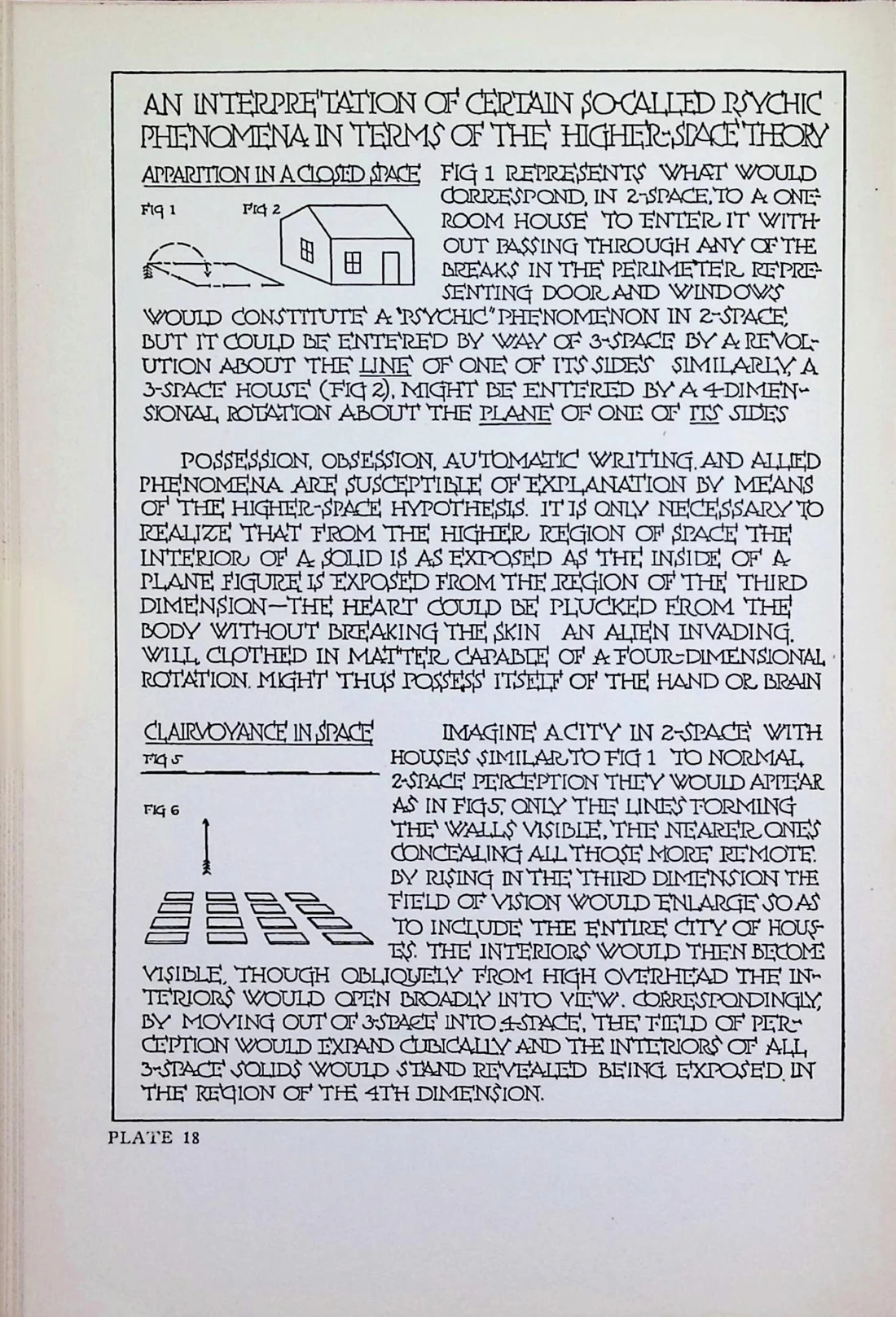
Plate 18, Reader page 47. The room on the plane motivates Bragdon’s proposed geometric explanation of an apparition in a closed space.
Claude Bragdon, A Primer of Higher Space, The Manas Press, 1913. Stickley Museum scan via Internet Archive. · Image source ↗ · Public Domain
What Bragdon’s diagram explains
Frederick George Lee collects stories of apparent encounters, including accounts that depend on witnesses identifying a figure. Bragdon concentrates on a different question: how an observer might see an arrival without seeing its route. His mechanism still leaves identification and the reliability of the claimed observation open. [17][16][2][3][4]
Perception, recognition and testimony
Seeing a figure, recognising a face and concluding that a spirit brought a message are different steps. The library witness reports a smoke-like shape becoming recognisable. The meaning he gives it comes from knowing the person he thought he saw. [3][4][5][6][7][8]
The surviving record also matters. A contributor’s letter, a story remembered at dinner, an editor’s enquiry and a quotation from an earlier history are different forms of transmission. Naming the chain of witnesses and documents helps readers follow the account without silently turning a later retelling into an original statement made at the event. [2][9][10][3][4][7]
For some of Lee’s witnesses, the personal meaning of an appearance matters most. For Leadbeater, several proposed causes can yield a familiar face. Bragdon asks how a figure might become visible without a visible route into the room. Each account starts from a different part of the experience. [13][3][4][5][6][7][8]
See references (10)
- The Other World, Reader page 304
- The Other World, Reader page 333
- The Other World, Reader page 334
- The Other World, Reader page 371
- The Other World, Reader page 372
- The Other World, Reader page 373
- The Other World, Reader page 374
- The Other World, Reader page 307
- The Other World, Reader page 308
- The Astral Plane, Reader page 102
In the library
The Other World
Reading note
The separately titled account draws on exact passages in the consulted Library edition.
The Astral Plane
Reading note
Separately attributed comparison with exact previously researched Library passages.
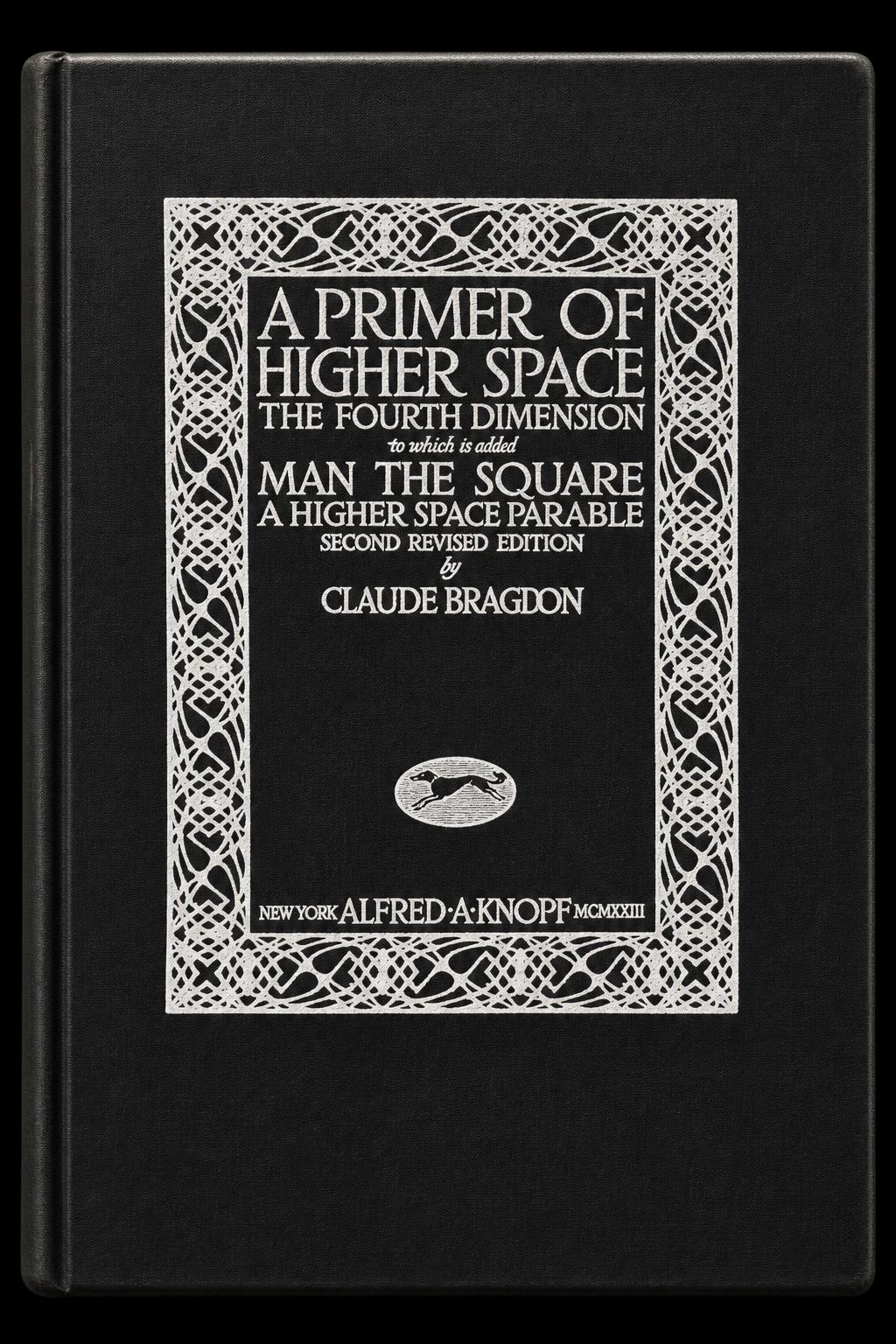
A Primer of Higher Space
Reading note
The separately titled account draws on exact passages in the consulted Library edition.
Sources
See references (18)
- José Guadalupe Posada, broadside about an apparition, ca. 1900–1913, The Met 46.46.187 ↗The Metropolitan Museum of Art, The Elisha Whittelsey Collection, The Elisha Whittelsey Fund, 1946. Zincograph and letterpress published by Antonio Vanegas Arroyo. Own catalogue and API confirm Public Domain image. Used as an example of a printed apparition story, not independent evidence for the narrated encounter.
- The Other World, Reader page 304Frederick George Lee, editor, The Other World; or, Glimpses of the Supernatural, two volumes, Henry S. King and Co., London, 1875. Exact consulted Library edition IMJ-0657-E001. Narratives and embedded quotations are attributed to this compilation; an original author is not represented as independently consulted merely because Lee quotes them. Reader positions are verified separately from printed pagination.Read this page in The Other World ↗
- The Other World, Reader page 333Frederick George Lee, editor, The Other World; or, Glimpses of the Supernatural, two volumes, Henry S. King and Co., London, 1875. Exact consulted Library edition IMJ-0657-E001. Narratives and embedded quotations are attributed to this compilation; an original author is not represented as independently consulted merely because Lee quotes them. Reader positions are verified separately from printed pagination.Read this page in The Other World ↗
- The Other World, Reader page 334Frederick George Lee, editor, The Other World; or, Glimpses of the Supernatural, two volumes, Henry S. King and Co., London, 1875. Exact consulted Library edition IMJ-0657-E001. Narratives and embedded quotations are attributed to this compilation; an original author is not represented as independently consulted merely because Lee quotes them. Reader positions are verified separately from printed pagination.Read this page in The Other World ↗
- The Other World, Reader page 371Frederick George Lee, editor, The Other World; or, Glimpses of the Supernatural, two volumes, Henry S. King and Co., London, 1875. Exact consulted Library edition IMJ-0657-E001. Narratives and embedded quotations are attributed to this compilation; an original author is not represented as independently consulted merely because Lee quotes them. Reader positions are verified separately from printed pagination.Read this page in The Other World ↗
- The Other World, Reader page 372Frederick George Lee, editor, The Other World; or, Glimpses of the Supernatural, two volumes, Henry S. King and Co., London, 1875. Exact consulted Library edition IMJ-0657-E001. Narratives and embedded quotations are attributed to this compilation; an original author is not represented as independently consulted merely because Lee quotes them. Reader positions are verified separately from printed pagination.Read this page in The Other World ↗
- The Other World, Reader page 373Frederick George Lee, editor, The Other World; or, Glimpses of the Supernatural, two volumes, Henry S. King and Co., London, 1875. Exact consulted Library edition IMJ-0657-E001. Narratives and embedded quotations are attributed to this compilation; an original author is not represented as independently consulted merely because Lee quotes them. Reader positions are verified separately from printed pagination.Read this page in The Other World ↗
- The Other World, Reader page 374Frederick George Lee, editor, The Other World; or, Glimpses of the Supernatural, two volumes, Henry S. King and Co., London, 1875. Exact consulted Library edition IMJ-0657-E001. Narratives and embedded quotations are attributed to this compilation; an original author is not represented as independently consulted merely because Lee quotes them. Reader positions are verified separately from printed pagination.Read this page in The Other World ↗
- The Other World, Reader page 307Frederick George Lee, editor, The Other World; or, Glimpses of the Supernatural, two volumes, Henry S. King and Co., London, 1875. Exact consulted Library edition IMJ-0657-E001. Narratives and embedded quotations are attributed to this compilation; an original author is not represented as independently consulted merely because Lee quotes them. Reader positions are verified separately from printed pagination.Read this page in The Other World ↗
- The Other World, Reader page 308Frederick George Lee, editor, The Other World; or, Glimpses of the Supernatural, two volumes, Henry S. King and Co., London, 1875. Exact consulted Library edition IMJ-0657-E001. Narratives and embedded quotations are attributed to this compilation; an original author is not represented as independently consulted merely because Lee quotes them. Reader positions are verified separately from printed pagination.Read this page in The Other World ↗
- The Other World, Reader page 305Frederick George Lee, editor, The Other World; or, Glimpses of the Supernatural, two volumes, Henry S. King and Co., London, 1875. Exact consulted Library edition IMJ-0657-E001. Narratives and embedded quotations are attributed to this compilation; an original author is not represented as independently consulted merely because Lee quotes them. Reader positions are verified separately from printed pagination.Read this page in The Other World ↗
- The Other World, Reader page 306Frederick George Lee, editor, The Other World; or, Glimpses of the Supernatural, two volumes, Henry S. King and Co., London, 1875. Exact consulted Library edition IMJ-0657-E001. Narratives and embedded quotations are attributed to this compilation; an original author is not represented as independently consulted merely because Lee quotes them. Reader positions are verified separately from printed pagination.Read this page in The Other World ↗
- The Astral Plane, Reader page 102C. W. Leadbeater, The Astral Plane. Exact Library edition IMJ-0005-E001. The proposed astral mechanisms are the author’s Theosophical explanations, not independently established physical observations.
Examine the original Library page
Preserved pilot PageID and original source leaf; new label reconciled to current presented Reader position.
to call them .ill vaguely "ghosts." Apparitions at the time- of death are by no means uncommon, and are very often really visits paid
Open the original page in The Astral Plane ↗Scan leaf 109 · C. W. Leadbeater
- Plate 18, a closed planar room and an ordinary house ↗Claude Bragdon, A Primer of Higher Space, The Manas Press, 1913. Stickley Museum scan via Internet Archive.
- A Primer of Higher Space, Reader page 39Claude Bragdon, A Primer of Higher Space (The Fourth Dimension), The Manas Press, Rochester, New York, 1913. Lumitheca Library edition IMJ-0599-E001.Read this page in A Primer of Higher Space ↗
- A Primer of Higher Space, Reader page 47Claude Bragdon, A Primer of Higher Space (The Fourth Dimension), The Manas Press, Rochester, New York, 1913. Lumitheca Library edition IMJ-0599-E001.Read this page in A Primer of Higher Space ↗
- A Primer of Higher Space, Reader page 27Claude Bragdon, A Primer of Higher Space (The Fourth Dimension), The Manas Press, Rochester, New York, 1913. Lumitheca Library edition IMJ-0599-E001.Read this page in A Primer of Higher Space ↗
- A Primer of Higher Space, Reader page 48Claude Bragdon, A Primer of Higher Space (The Fourth Dimension), The Manas Press, Rochester, New York, 1913. Lumitheca Library edition IMJ-0599-E001.Read this page in A Primer of Higher Space ↗