Apostolic Succession
Explore what apostolic succession means, why Anglican and Roman Catholic accounts of ordination differ, and how Leadbeater explains it through a spiritual reservoir.
In this article
What does apostolic succession mean?
Apostolic succession is the continuity of the Church with the apostles. In churches that understand it through bishops, episcopal ministry is handed on through consecration. The term can also refer to continuity in apostolic teaching, worship and mission. How a church understands succession affects which ordinations it recognizes. [1][2][3]
Why Anglican and Roman Catholic orders are disputed
In Apostolicae curae (1896), Pope Leo XIII judged Anglican orders invalid. He argued that the ordination rite was defective in form and intention. The Archbishops of Canterbury and York replied in Saepius Officio (1897) that the Anglican rite retained the office and intention needed for ordination. [4][5]
See references (2)
The Science of the Sacraments by Charles W. Leadbeater
Charles W. Leadbeater describes a spiritual reservoir fed by unselfish devotion and says Christ reserved part of it for the Church. His bell-shaped diagram assigns a different part to each office: the rim to a deacon, the main body to a priest and the highest part to a bishop. [6][7][8][9][10][11]
Leadbeater understands succession as handing on the ability to draw from that reservoir. Ordained a priest in the Church of England, he says he could perceive Anglican priests drawing on it. He brings that claimed observation into the dispute over Anglican orders. [9][12][13][14][15]
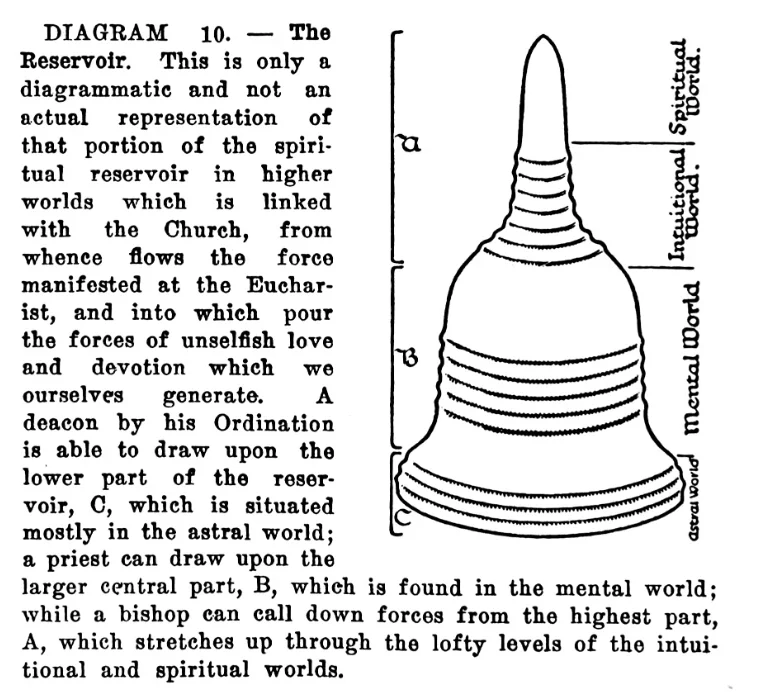
Diagram 10, printed page 308. Leadbeater pictures the parts of the reservoir that he assigns to deacon, priest and bishop.
The Science of the Sacraments by Charles W. Leadbeater, The St. Alban Press, 1920. Library facsimile. · Image source ↗ · Public Domain
See references (10)
- The Science of the Sacraments, printed p. 303, Reader page 315
- The Science of the Sacraments, printed p. 304, Reader page 316
- The Science of the Sacraments, printed p. 305, Reader page 317
- The Science of the Sacraments, printed p. 306, Reader page 318
- The Science of the Sacraments, printed p. 308, Reader page 320
- The Science of the Sacraments, printed p. 309, Reader page 321
- The Science of the Sacraments, printed p. 310, Reader page 322
- The Science of the Sacraments, printed p. 312, Reader page 324
- The Science of the Sacraments, printed p. 313, Reader page 325
- The Science of the Sacraments, printed p. 314, Reader page 326
What is understood to pass on
Leo XIII and the Anglican archbishops argue over what the rite says and what the church intends through it. Leadbeater asks whether ordination gives the minister a capacity he believes can be observed. Those approaches explain why he presents a diagram of what the others address through liturgy and history. [4][5][9][10][14]
In the library
The Science of the Sacraments
Reading note
The separately titled account draws on exact passages in the consulted Library edition.
Sources
See references (15)
- Catechism of the Catholic Church, §§1554–1571 ↗Holy See, Catechism of the Catholic Church, English edition.
- Catechism of the Catholic Church, §§1575–1576 ↗Holy See, Catechism of the Catholic Church, English edition.
- Sharing in the Apostolic Communion, §§71–78 ↗Anglican–Methodist International Commission report, archived by the Anglican Communion.
- Apostolicae curae, 1896 ↗Leo XIII, Apostolicae curae, 13 September 1896. Holy See, Latin original.
- Saepius Officio, 1897 ↗Archbishops Frederick Temple of Canterbury and William Maclagan of York, reply to Leo XIII, 1897. Project Canterbury transcription.
- The Science of the Sacraments, printed p. 303, Reader page 315Charles W. Leadbeater, The Science of the Sacraments, The St. Alban Press, 1920. Exact Library edition IMJ-0615-E001.Read this page in The Science of the Sacraments ↗
- The Science of the Sacraments, printed p. 304, Reader page 316Charles W. Leadbeater, The Science of the Sacraments, The St. Alban Press, 1920. Exact Library edition IMJ-0615-E001.Read this page in The Science of the Sacraments ↗
- The Science of the Sacraments, printed p. 305, Reader page 317Charles W. Leadbeater, The Science of the Sacraments, The St. Alban Press, 1920. Exact Library edition IMJ-0615-E001.Read this page in The Science of the Sacraments ↗
- The Science of the Sacraments, printed p. 306, Reader page 318Charles W. Leadbeater, The Science of the Sacraments, The St. Alban Press, 1920. Exact Library edition IMJ-0615-E001.Read this page in The Science of the Sacraments ↗
- The Science of the Sacraments, printed p. 308, Reader page 320Charles W. Leadbeater, The Science of the Sacraments, The St. Alban Press, 1920. Exact Library edition IMJ-0615-E001.Read this page in The Science of the Sacraments ↗
- The Science of the Sacraments, printed p. 309, Reader page 321Charles W. Leadbeater, The Science of the Sacraments, The St. Alban Press, 1920. Exact Library edition IMJ-0615-E001.Read this page in The Science of the Sacraments ↗
- The Science of the Sacraments, printed p. 310, Reader page 322Charles W. Leadbeater, The Science of the Sacraments, The St. Alban Press, 1920. Exact Library edition IMJ-0615-E001.Read this page in The Science of the Sacraments ↗
- The Science of the Sacraments, printed p. 312, Reader page 324Charles W. Leadbeater, The Science of the Sacraments, The St. Alban Press, 1920. Exact Library edition IMJ-0615-E001.Read this page in The Science of the Sacraments ↗
- The Science of the Sacraments, printed p. 313, Reader page 325Charles W. Leadbeater, The Science of the Sacraments, The St. Alban Press, 1920. Exact Library edition IMJ-0615-E001.Read this page in The Science of the Sacraments ↗
- The Science of the Sacraments, printed p. 314, Reader page 326Charles W. Leadbeater, The Science of the Sacraments, The St. Alban Press, 1920. Exact Library edition IMJ-0615-E001.Read this page in The Science of the Sacraments ↗