The Angel of Death
The Angel of Death can be a divine messenger or a figure of passage. Compare Quran 32:11 with Christian art and a funeral address in J. R. Francis’s anthology.
In this article
Understanding the angel of death
The Angel of Death gives death a figure who can come for a person, carry out a divine command or mark a passage into another life. The role changes with the source. A scriptural messenger and a figure in a funeral address do different work. [1][2][3][4][8]
In Quran 32:11, an angel has the task of taking people at death before their return to God. In the anthology J. R. Francis compiled, the figure can also be an artistic alternative to a skeleton or a way of speaking about welcome after death. [1][2][3][4][8]
See references (5)
- The Encyclopaedia of Death and Life in the Spirit-World, Volume I, printed p. 160, Reader page 159
- The Encyclopaedia of Death and Life in the Spirit-World, Volume I, printed p. 161, Reader page 160
- The Encyclopaedia of Death and Life in the Spirit-World, Volume I, printed p. 376, Reader page 375
- The Encyclopaedia of Death and Life in the Spirit-World, Volume I, printed p. 378, Reader page 377
- Quran, As-Sajdah 32:10–11
The Angel of Death in the Quran
In As-Sajdah 32:10–11, a question about being raised after the body has disintegrated is answered by naming the Angel of Death. The angel takes those placed in its charge, and they are returned to their Lord. The verse identifies the figure by its commission and gives it a part in the passage between death and return to God. [8]
The Encyclopaedia of Death and Life, Volume I, compiled by J. R. Francis
J. R. Francis’s section on the Dance of Death begins with debates about how antiquity represented mortality. The passage contrasts skeletons, winged figures and other symbols. It is footnoted to Holbein’s Dance of Death, but this volume does not identify the edition or an author for every line of the historical commentary. [3][5][4]
The commentary prefers a graceful angel to the skulls and skeletons it associates with the Dance of Death. Its author appeals to scripture without naming a verse here. The choice tells the reader what kind of image the writer believes can give death dignity. [4]
Elsewhere, a funeral discourse attributed to D. P. Kayner describes ministering spirits gathering for Barnes Coon’s departure. Its language gives the death angel a golden key opening a gateway to continuing life. The image operates within a consolatory Spiritualist address, beside a much more populated scene of helpers and welcome. [1][2]
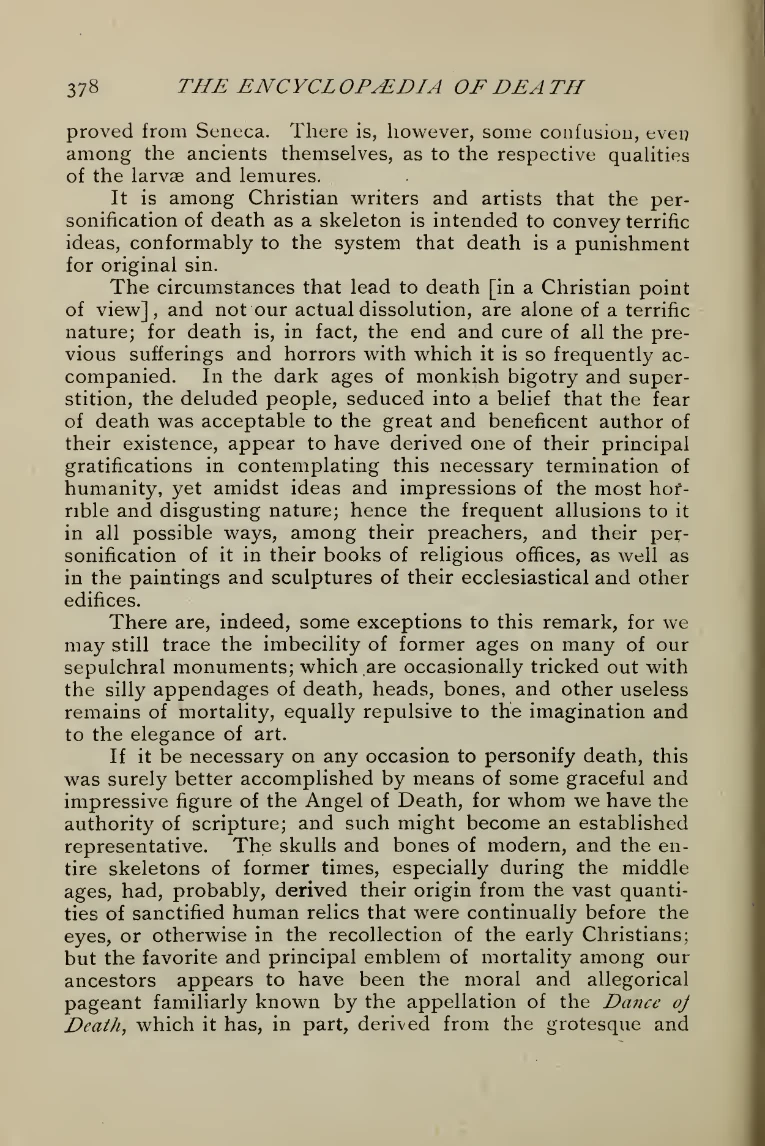
Source facsimile: The Encyclopaedia of Death and Life in the Spirit-World, Volume I (1903), printed p. 378, Reader page 377.
The Encyclopaedia of Death and Life in the Spirit-World, Volume I, fourth edition, 1903. Public-domain historical page extracted from the checksum-verified Library PDF. · Image source ↗ · Public Domain
See references (5)
- The Encyclopaedia of Death and Life in the Spirit-World, Volume I, printed p. 160, Reader page 159
- The Encyclopaedia of Death and Life in the Spirit-World, Volume I, printed p. 161, Reader page 160
- The Encyclopaedia of Death and Life in the Spirit-World, Volume I, printed p. 376, Reader page 375
- The Encyclopaedia of Death and Life in the Spirit-World, Volume I, printed p. 378, Reader page 377
- The Encyclopaedia of Death and Life in the Spirit-World, Volume I, printed p. 377, Reader page 376
A messenger, a figure in art and a word of consolation
Quran 32:11 gives the angel a task. The art commentary recommends an appearance. Kayner’s funeral discourse gives a death angel a golden key, using the image to offer consolation. The figures can all mark a passage, while their authority and purpose come from different sources. [1][2][4][8]
The anthology itself prints a skeleton beside a rising figure. That design gives skeletal Death a place in a picture of continuing life, even though the later commentary prefers the angel. [6][4]
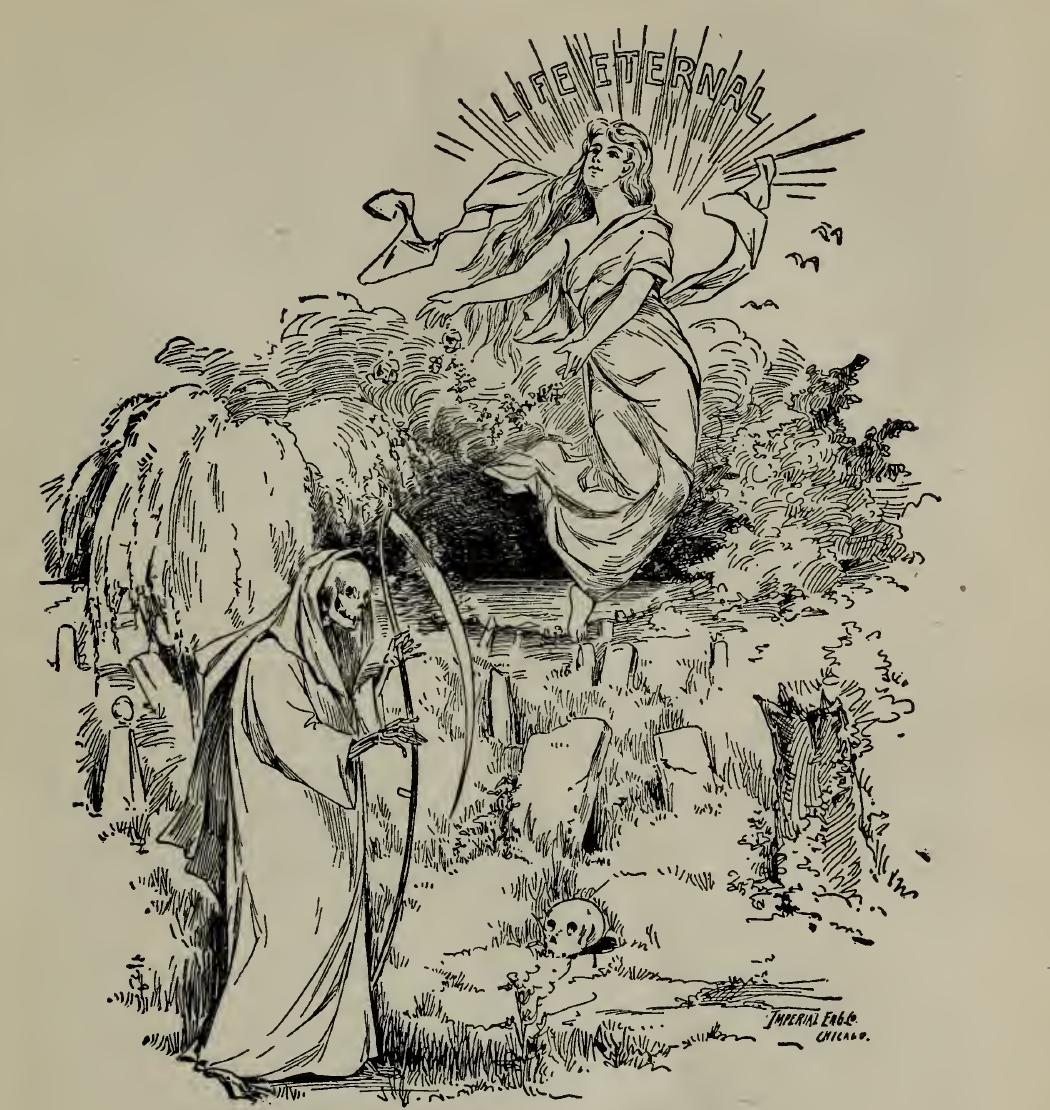
Death and Life Eternal Contrasted, printed p. 25 of Francis’s anthology. This skeletal Death differs from the graceful angel preferred by the later commentary. The rising figure makes the book’s argument for continuing life visible.
Unidentified artist. The Encyclopaedia of Death and Life in Spirit-World, Volume I, fourth edition, 1903. Public Domain. · Image source ↗ · Public Domain
See references (5)
- The Encyclopaedia of Death and Life in the Spirit-World, Volume I, printed p. 160, Reader page 159
- The Encyclopaedia of Death and Life in the Spirit-World, Volume I, printed p. 161, Reader page 160
- The Encyclopaedia of Death and Life in the Spirit-World, Volume I, printed p. 378, Reader page 377
- The Encyclopaedia of Death and Life in the Spirit-World, Volume I, printed p. 25, Reader page 24
- Quran, As-Sajdah 32:10–11
Read further in the library
The Encyclopaedia of Death and Life in the Spirit-World, Volume I
Reading note
The separately titled account draws on exact passages in the consulted Library edition.
Sources
See references (8)
- The Encyclopaedia of Death and Life in the Spirit-World, Volume I, printed p. 160, Reader page 159J. R. Francis (compiler), The Encyclopaedia of Death and Life in the Spirit-World, Volume I, fourth edition. The Progressive Thinker Publishing House, Chicago, 1903. Individual authors, communicators and quoted sources identified in each account.Read this page in The Encyclopaedia of Death and Life in the Spirit-World, Volume I ↗Return to text ↑
- The Encyclopaedia of Death and Life in the Spirit-World, Volume I, printed p. 161, Reader page 160J. R. Francis (compiler), The Encyclopaedia of Death and Life in the Spirit-World, Volume I, fourth edition. The Progressive Thinker Publishing House, Chicago, 1903. Individual authors, communicators and quoted sources identified in each account.Read this page in The Encyclopaedia of Death and Life in the Spirit-World, Volume I ↗Return to text ↑
- The Encyclopaedia of Death and Life in the Spirit-World, Volume I, printed p. 376, Reader page 375J. R. Francis (compiler), The Encyclopaedia of Death and Life in the Spirit-World, Volume I, fourth edition. The Progressive Thinker Publishing House, Chicago, 1903. Individual authors, communicators and quoted sources identified in each account.Read this page in The Encyclopaedia of Death and Life in the Spirit-World, Volume I ↗Return to text ↑
- The Encyclopaedia of Death and Life in the Spirit-World, Volume I, printed p. 378, Reader page 377J. R. Francis (compiler), The Encyclopaedia of Death and Life in the Spirit-World, Volume I, fourth edition. The Progressive Thinker Publishing House, Chicago, 1903. Individual authors, communicators and quoted sources identified in each account.Read this page in The Encyclopaedia of Death and Life in the Spirit-World, Volume I ↗Return to text ↑
- The Encyclopaedia of Death and Life in the Spirit-World, Volume I, printed p. 377, Reader page 376J. R. Francis (compiler), The Encyclopaedia of Death and Life in the Spirit-World, Volume I, fourth edition. The Progressive Thinker Publishing House, Chicago, 1903. Individual authors, communicators and quoted sources identified in each account.Read this page in The Encyclopaedia of Death and Life in the Spirit-World, Volume I ↗Return to text ↑
- The Encyclopaedia of Death and Life in the Spirit-World, Volume I, printed p. 25, Reader page 24J. R. Francis (compiler), The Encyclopaedia of Death and Life in the Spirit-World, Volume I, fourth edition. The Progressive Thinker Publishing House, Chicago, 1903. Individual authors, communicators and quoted sources identified in each account.Read this page in The Encyclopaedia of Death and Life in the Spirit-World, Volume I ↗Return to text ↑
- The Encyclopaedia of Death and Life in Spirit-World, Volume I, printed p. 25, Reader page 24J. R. Francis (compiler), The Encyclopaedia of Death and Life in Spirit-World, Volume I, fourth edition, Progressive Thinker Publishing House, Chicago, 1903. Individual contributors identified in the article.Read this page in The Encyclopaedia of Death and Life in the Spirit-World, Volume I ↗
- Quran, As-Sajdah 32:10–11 ↗Arabic text and translation by Mustafa Khattab, The Clear Quran.Return to text ↑