Analogical Colour Harmony
Analogical colour harmony uses a shared character across varied hues. See how Babbitt explained it through sunset light and Venetian architecture.
In this article
A shared quality across different parts
Analogical colour harmony gives different parts of a picture a shared colour cast. At sunset a golden light can reach clouds and ground that retain different hues and degrees of brightness. The shared cast gives the scene a visual unity. [3][4]
The Principles of Light and Color by Edwin D. Babbitt
In The Principles of Light and Color, Edwin D. Babbitt describes the changing sky at sunset. A golden light passes over a scene containing distinct clouds and shadows. He calls the unity this common quality produces analogical harmony. [3]
Babbitt gives an architectural example from John Ruskin’s The Stones of Venice. The Venetian arches repeat a general outline, while their ornaments and carved capitals vary. The repeated outline plays the same role as the golden light in the landscape. [4]
The Principles of Harmony and Contrast of Colours by Michel Eugène Chevreul
In The Principles of Harmony and Contrast of Colours, Michel Eugène Chevreul describes a neutral grey acquiring a yellowish cast beside violet. Proximity changes the appearance of grey without changing the grey sample. [2]
How analogy differs from contrast
Babbitt’s sunset illustrates a quality shared across a scene. Chevreul’s grey and violet show a different effect in which adjacent colours change each other’s appearance. Babbitt demonstrates that second effect with identical grey circles set in different coloured rings. [3][5][2]
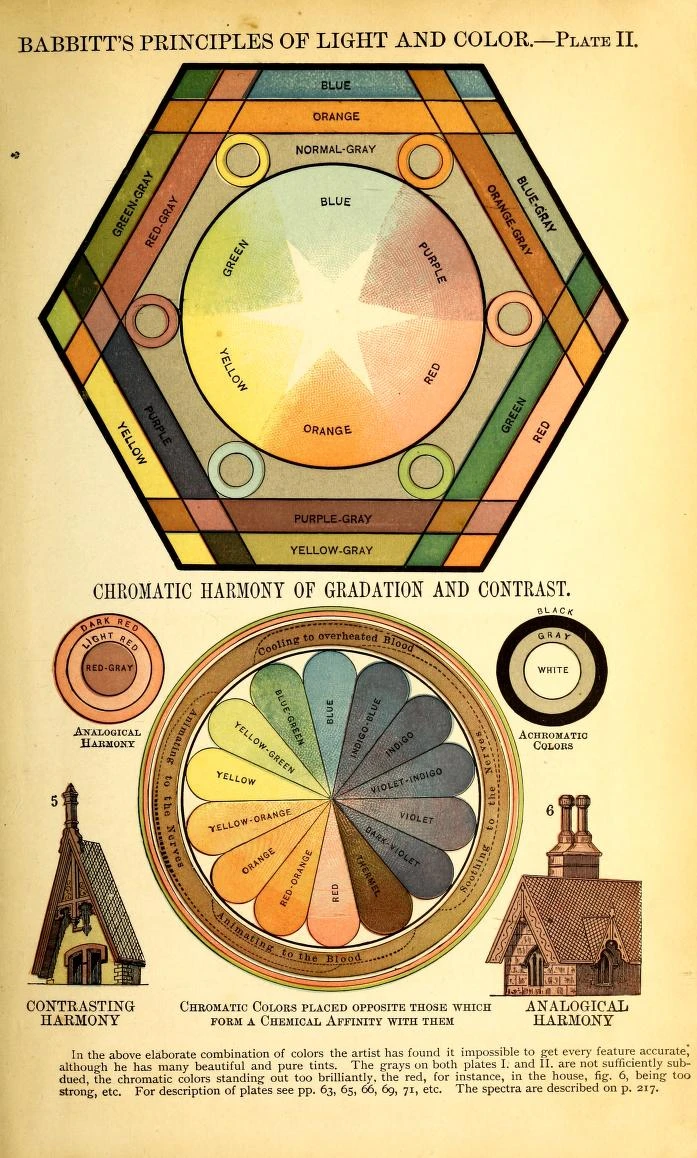
Babbitt uses identical grey centres with different coloured surrounds to illustrate contrast. It is a different effect from the shared colour cast he calls analogical harmony.
Edwin D. Babbitt, The Principles of Light and Color, first edition (1878), Plate II. Smithsonian Libraries and Archives. · Image source ↗ · CC0
In the library
The Principles of Light and Color
Reading note
The separately titled account draws on exact passages in the consulted Library edition.
Sources
See references (5)
- The Principles of Light and Color, 1878, Plate II ↗Edwin D. Babbitt, The Principles of Light and Color, first edition (1878), Plate II. Smithsonian Libraries and Archives.
- The Principles of Harmony and Contrast of Colours, p. 26, §70 ↗Michel Eugène Chevreul, translated by Charles Martel, The Principles of Harmony and Contrast of Colours, London, 1854.
- The Principles of Light and Color, printed p. 31, Reader page 38Edwin D. Babbitt, The Principles of Light and Color, second edition, College of Fine Forces, East Orange, New Jersey, 1896. Lumitheca Library edition IMJ-0607-E001.Read this page in The Principles of Light and Color ↗
- The Principles of Light and Color, printed p. 33, Reader page 40Edwin D. Babbitt, The Principles of Light and Color, second edition, College of Fine Forces, East Orange, New Jersey, 1896. Lumitheca Library edition IMJ-0607-E001.Read this page in The Principles of Light and Color ↗
- The Principles of Light and Color, printed p. 70, Reader page 77Edwin D. Babbitt, The Principles of Light and Color, second edition, College of Fine Forces, East Orange, New Jersey, 1896. Lumitheca Library edition IMJ-0607-E001.Read this page in The Principles of Light and Color ↗