Amitābha, the Buddha of Infinite Light
Who is Amitābha? Meet the Buddha of Infinite Light, explore his relation to Amitāyus and Sukhāvatī, and see how artists picture him with two attendants.
In this article
Who is Amitābha?
Amitābha, the Buddha of Infinite Light, presides over Sukhāvatī, the western Pure Land. Devotees in Mahāyāna traditions aspire to be reborn there and continue towards awakening. The Japanese name is Amida. Amitāyus, or Infinite Life, names the same Buddha in some texts and a distinct form in some images. [2][3][4][5][1]
See references (5)
- The Gods of Northern Buddhism, printed p. 37, Reader page 89
- The Gods of Northern Buddhism, printed p. 38, Reader page 90
- The Gods of Northern Buddhism, printed p. 39, Reader page 91
- The Gods of Northern Buddhism, printed p. 41, Reader page 93
- The Display of the Pure Land of Sukhāvatī, Toh 115, §§ 1.8–1.11
The Gods of Northern Buddhism by Alice Getty
Alice Getty describes Amitābha seated with his hands in meditation. In her account of Amitāyus, a crowned figure holds a vase of ambrosia. The vase directs attention to life and longevity, giving the association a form that can be recognised in an image. [1][3]
Getty also describes a triad in which Avalokiteśvara and Mahāsthāmaprāpta accompany the Buddha. She gives their Japanese names, Kannon and Seishi, in her discussion of Amida. [4]
The Display of the Pure Land of Sukhāvatī
In the shorter Pure Land sūtra, Śākyamuni explains the names Amitāyus and Amitābha through immeasurable lifespan and unhindered light. He asks people to dedicate their virtue towards rebirth in Sukhāvatī. Those born there meet holy companions and progress on the path without falling back. [5]
A Korean painting of the triad
Amitābha sits between two smaller, standing attendants in this Goryeo scroll. The difference in scale draws the eye to the Buddha. The three figures give a Korean example of the grouping Getty traces across Buddhist art. [6][3]
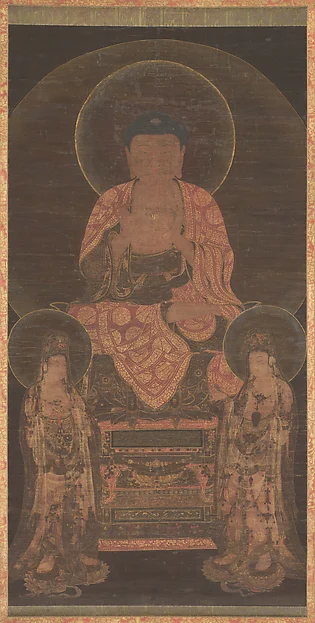
Amitābha with two attendants in a Goryeo dynasty hanging scroll, circa 13th century.
The Metropolitan Museum of Art. Goryeo dynasty, Korea, circa 13th century. Rogers Fund, 1930. Accession 30.76.298. · Image source ↗ · CC0
In the library
The Gods of Northern Buddhism
Reading note
Read Alice Getty’s illustrated discussion of Amitābha.
Sources
See references (6)
- The Gods of Northern Buddhism, printed p. 37, Reader page 89Alice Getty, The Gods of Northern Buddhism, 1928 revised second edition, Munshiram Manoharlal reprint. Lumitheca Library edition IMJ-0597-E001.Read this page in The Gods of Northern Buddhism ↗
- The Gods of Northern Buddhism, printed p. 38, Reader page 90Alice Getty, The Gods of Northern Buddhism, 1928 revised second edition, Munshiram Manoharlal reprint. Lumitheca Library edition IMJ-0597-E001.Read this page in The Gods of Northern Buddhism ↗
- The Gods of Northern Buddhism, printed p. 39, Reader page 91Alice Getty, The Gods of Northern Buddhism, 1928 revised second edition, Munshiram Manoharlal reprint. Lumitheca Library edition IMJ-0597-E001.Read this page in The Gods of Northern Buddhism ↗
- The Gods of Northern Buddhism, printed p. 41, Reader page 93Alice Getty, The Gods of Northern Buddhism, 1928 revised second edition, Munshiram Manoharlal reprint. Lumitheca Library edition IMJ-0597-E001.Read this page in The Gods of Northern Buddhism ↗
- The Display of the Pure Land of Sukhāvatī, Toh 115, §§ 1.8–1.11 ↗The Display of the Pure Land of Sukhāvatī, Toh 115, §§ 1.8–1.11. Translation credit: Sakya Pandita Translation Group. Published by 84000.
- Amitabha triad ↗The Metropolitan Museum of Art. Goryeo dynasty, Korea, circa 13th century. Rogers Fund, 1930. Accession 30.76.298.