Alchemical Puffers
Alchemical puffers were furnace workers mocked for chasing transmutation. See how a Bruegel print and De Givry’s account gave the insult different meanings.
In this article
Why were some alchemists called puffers?
In European alchemy, puffer was a term of ridicule for someone who kept a furnace going with bellows in the hope of making gold. Writers used it to question the worker’s understanding of the Great Work and the value of costly attempts at transmutation. [3][4]
The engraving after Pieter Bruegel the Elder brings the cost into the household. An alchemist works at the furnace while a child searches an empty cupboard. In the background, the family appears at the poorhouse. [4][1]
Witchcraft Magic & Alchemy by Grillot de Givry
In Witchcraft Magic & Alchemy, Grillot de Givry says the puffer failed to understand the symbols of the Great Work. For him an adept sees a relation between creation and what happens in the vessel. He also credits the puffers’ costly trials with occasional discoveries, connecting their work with the history of chemistry. [3][4]
De Givry reads the purse and the children’s search for food as signs of what the project costs the family. He also studies the equipment in the crowded workshop, treating the satire as a record of what a laboratory could contain. [4]
At the end of the chapter, Heinrich Khunrath’s engraving places an oratory alongside a laboratory. A figure prays on one side while apparatus occupies the other. De Givry takes the arrangement as an image of an ideal practice. [5][6]
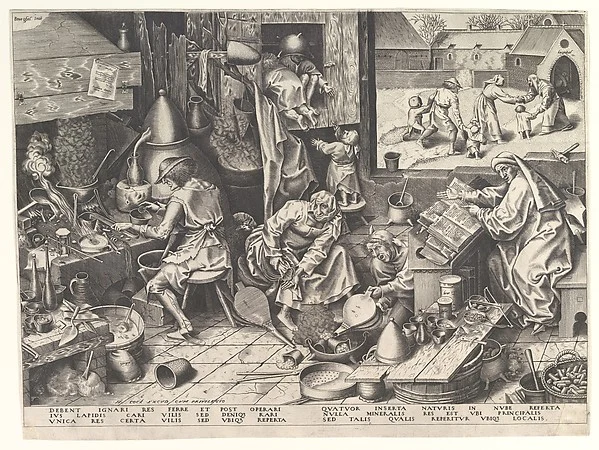
The Alchemist, engraved by Philips Galle after Pieter Bruegel the Elder and published by Hieronymus Cock. The scene at upper right shows where the family ends up. De Givry reproduces the composition as figure 354.
The Metropolitan Museum of Art, 26.72.29. Public domain. · Image source ↗ · Public Domain
A household in ruin and a laboratory beside an oratory
The furnace in Bruegel’s satire helps explain the empty cupboard. In Khunrath’s engraving the apparatus has a place beside prayer. De Givry uses the two images to show what he thinks separates the puffer’s costly trials from an adept’s work. [4][5][6][1][2][7]
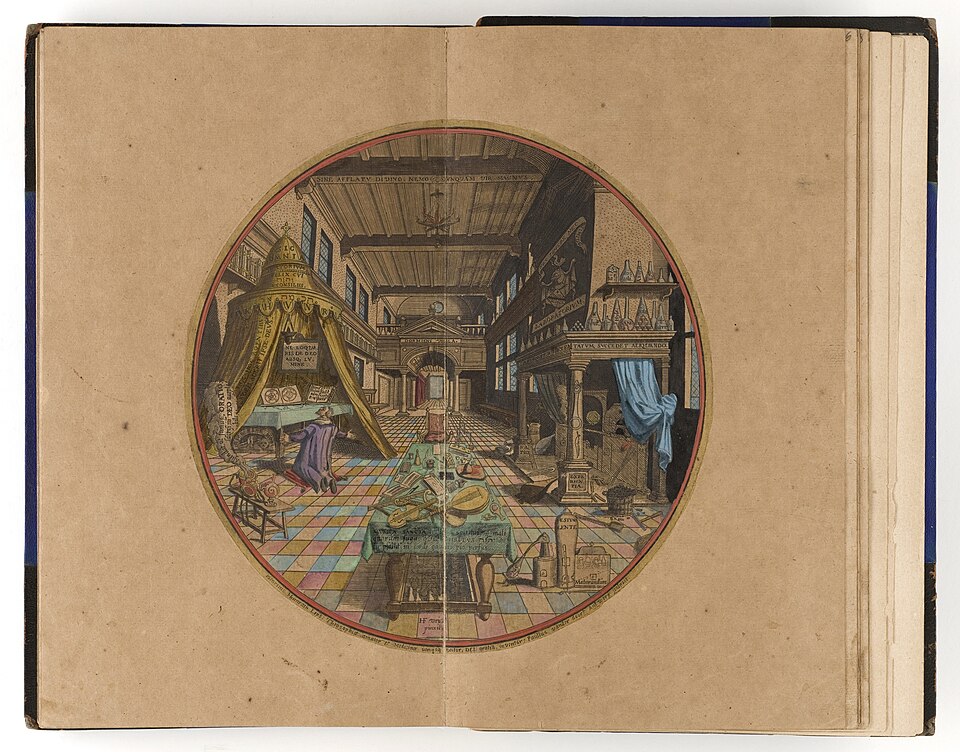
Khunrath’s oratory and laboratory share a single room in this engraving from the 1609 edition.
Heinrich Khunrath, Amphitheatrum sapientiae aeternae, 1609. Wellcome Collection L0048284, via Wikimedia Commons. · Image source ↗ · CC BY 4.0
See references (6)
- The Alchemist, after Pieter Bruegel the Elder
- Amphitheatrum Sapientiae Aeternae Solius Verae
- Witchcraft Magic & Alchemy, printed p. 375, Reader page 373
- Witchcraft Magic & Alchemy, printed p. 383, Reader page 381
- Witchcraft Magic & Alchemy, printed p. 384, Reader page 382
- Oratory and laboratory in Heinrich Khunrath’s Amphitheatrum, 1609
Read further in the library
Witchcraft Magic and Alchemy
Reading note
The separately titled account draws on exact passages in the consulted Library edition.
Sources
See references (7)
- The Alchemist, after Pieter Bruegel the Elder ↗Philips Galle after Pieter Bruegel the Elder, published by Hieronymus Cock. The Metropolitan Museum of Art, 26.72.29.Return to text ↑
- Amphitheatrum Sapientiae Aeternae Solius Verae ↗Heinrich Khunrath, Hanau, Wilhelm Antonius, 1609. Science History Institute Digital Collections.Return to text ↑
- Witchcraft Magic & Alchemy, printed p. 350, Reader page 346Grillot de Givry, Witchcraft Magic & Alchemy, translated by J. Courtenay Locke. Boston and New York, Houghton Mifflin Company, 1931.Read this page in Witchcraft Magic and Alchemy ↗Return to text ↑
- Witchcraft Magic & Alchemy, printed p. 375, Reader page 373Grillot de Givry, Witchcraft Magic & Alchemy, translated by J. Courtenay Locke. Boston and New York, Houghton Mifflin Company, 1931.Read this page in Witchcraft Magic and Alchemy ↗Return to text ↑
- Witchcraft Magic & Alchemy, printed p. 383, Reader page 381Grillot de Givry, Witchcraft Magic & Alchemy, translated by J. Courtenay Locke. Boston and New York, Houghton Mifflin Company, 1931.Read this page in Witchcraft Magic and Alchemy ↗Return to text ↑
- Witchcraft Magic & Alchemy, printed p. 384, Reader page 382Grillot de Givry, Witchcraft Magic & Alchemy, translated by J. Courtenay Locke. Boston and New York, Houghton Mifflin Company, 1931.Read this page in Witchcraft Magic and Alchemy ↗Return to text ↑
- Oratory and laboratory in Heinrich Khunrath’s Amphitheatrum, 1609 ↗Heinrich Khunrath, Amphitheatrum sapientiae aeternae, 1609. Wellcome Collection L0048284, via Wikimedia Commons.Return to text ↑