Colours of the Alchemical Work
Why did alchemists write about black, white, red and the Green Lion? See how historical texts and a manuscript painting represent the work.
In this article
What do the colours of the alchemical work mean?
Alchemical writers used colours to mark changes in the Great Work, the process meant to yield the philosophers’ stone. In the sequence described here, black comes first. White marks a stone that was supposed to make silver, and red marks one that was supposed to make gold. [1][2]
Witchcraft Magic & Alchemy by Grillot de Givry
Grillot de Givry calls the black stage the raven’s head and likens the final red to a ruby. He also discusses green as an intermediate colour and quotes Heinrich Khunrath, who connects green with germination and the Green Lion with the philosophers’ gold. [2]
The manuscript painting below shows riders on black, red and white mounts above a dragon. In the prose the colours come in a sequence, while the picture shows them together. De Givry notes that alchemists could divide and name the operations in different ways. [1][3][2]
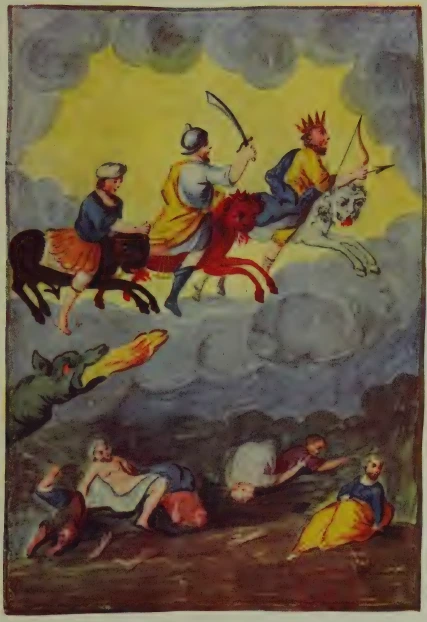
The Three Colours of the Work, from the seventeenth-century Figures d’Abraham Juif. The painting shows all three colours together.
Figures d’Abraham Juif, seventeenth century, Bibliothèque nationale de France, Français 14765. · Image source ↗ · Public Domain
Why the Green Lion appears between stages
The three colours mark the main stages in De Givry’s account. Khunrath’s emphasis on green and germination points to change still under way, giving the intermediate colour its own emblem. [1][2]
In the library
Witchcraft Magic and Alchemy
Reading note
The separately titled account draws on exact passages in the consulted Library edition.
Sources
See references (3)
- Witchcraft Magic & Alchemy, Reader page 360Grillot de Givry, Witchcraft Magic & Alchemy, translated by J. Courtenay Locke. Boston and New York, Houghton Mifflin Company, 1931.Read this page in Witchcraft Magic and Alchemy ↗
- Witchcraft Magic & Alchemy, printed p. 368, Reader page 366Grillot de Givry, Witchcraft Magic & Alchemy, translated by J. Courtenay Locke. Boston and New York, Houghton Mifflin Company, 1931.Read this page in Witchcraft Magic and Alchemy ↗
- Witchcraft Magic & Alchemy, printed p. 367, Reader page 365Grillot de Givry, Witchcraft Magic & Alchemy, translated by J. Courtenay Locke. Boston and New York, Houghton Mifflin Company, 1931.Read this page in Witchcraft Magic and Alchemy ↗