Ahimsa
Ahimsa means non-harming. Compare Buddhist restraint, Jain efforts to minimise injury and Vivekananda’s questions about power, motive and consequences.
In this article
Understanding the concept
Ahimsa is the principle of non-harming or non-injury. Hindu, Buddhist and Jain texts give it different forms in practice. The sources here ask what another being experiences, how much injury a householder can avoid and what matters when an action has mixed effects. [4][1][2]
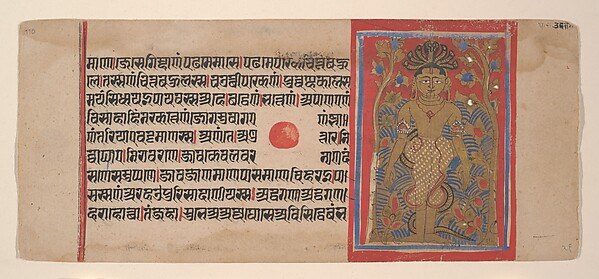
Pārśvanātha’s Austerities, fifteenth-century Gujarat. A Jain manuscript depicts the Jina meditating beneath the serpent king’s hood.
The Metropolitan Museum of Art. Anonymous Gift, 1957. Accession 57.185.4. Public Domain (CC0). · Image source ↗ · CC0
The Dhammapada: considering the other being
Dhammapada 129–130, in Acharya Buddharakkhita’s translation, connects restraint with recognition that other beings fear violence and value life. The verses ask the reader to consider another’s position, then reject both killing and causing someone else to kill. [1]
Outlines of Jainism by J. L. Jaini
In Outlines of Jainism, Jagmanderlal Jaini distinguishes the restraint of a householder from stricter ascetic conduct. He uses food to explain a difficulty: maintaining ordinary life involves injury to other living beings. His practical account asks a person to reduce that injury as far as possible. [2]
Karma-Yoga by Swami Vivekananda
Swami Vivekananda proposes non-injury as a general ethical ideal within his discussion of duty. Elsewhere he asks what makes non-resistance a virtue. He distinguishes a person who possesses the power to resist but freely refrains from someone who cannot resist and gives that inability a noble name. [5][6][7][4]
Vivekananda reads Arjuna’s hesitation through his distinction between inability to resist and the voluntary decision to refrain. He treats resistance to evil as an earlier stage on the way to what he calls higher non-resistance. This is how he relates strength and motive in the episode. [6][7][8]
The book then raises a different difficulty: an act can benefit some beings while harming others. Vivekananda uses the effects of speaking, eating and sustaining life to argue that no work is wholly free of mixed consequences. His proposed answer is unattached action, rather than the belief that every trace of injury can be removed from outward activity. [9][10][11][12]
Vivekananda’s discussion turns polemical when it describes Jain renunciation. Jaini’s own account gives minimizing unavoidable injury a central place. Reading the two accounts together lets the reader see the Jain ethical rule in a source that explains it in its own terms. [11][12][2]
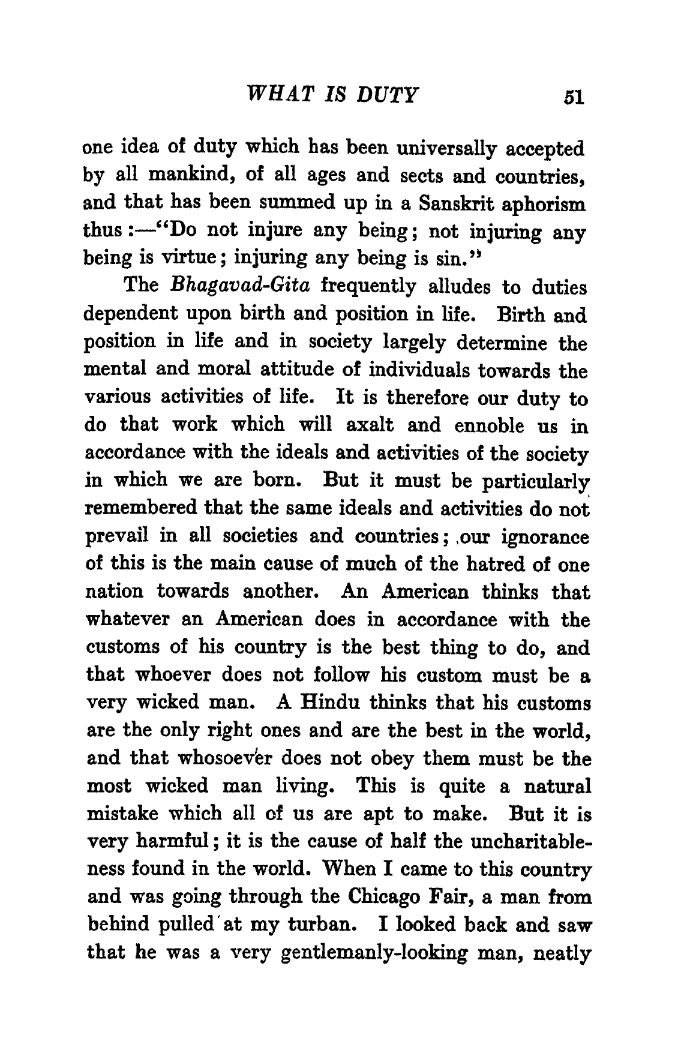
Source facsimile: Karma-Yoga (1939), Reader page 53. An ideal of non-injury enters Vivekananda’s discussion of duty.
Swami Vivekananda, Karma-Yoga, English second printing in the 1939 combined volume. Historical public-domain text, exact checksum-verified Library scan. · Image source ↗ · Public Domain
See references (10)
Harm, motive and restraint
The Dhammapada asks a person to consider another being’s fear of harm. Jaini distinguishes how much injury people can avoid in different ways of life. Vivekananda asks what can be done when one action helps some beings and hurts others. Each starts from recognising harm and gives the person a different problem to work through. [1][2][6][10]
Read further in the library
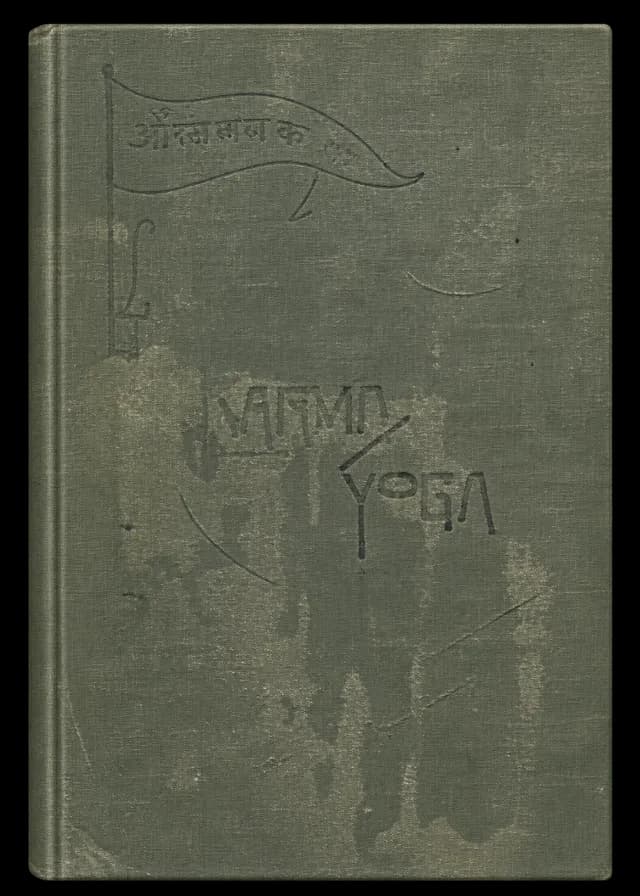
Karma Yoga
Reading note
The separately titled account draws on exact passages in the consulted Library edition.
Sources
See references (12)
- Dhammapada 129–130, translated by Acharya Buddharakkhita ↗Dhammapada, Dandavagga, verses 129–130. Acharya Buddharakkhita’s English translation, Access to Insight. Short selected verses read; no invented Library pagination.Return to text ↑
- J. L. Jaini, Outlines of Jainism, Part I, chapter III: Ethics ↗J. L. Jaini, Outlines of Jainism (1916), Part I, chapter III. Sections on the lay vows and food, including the author’s explanation of unavoidable injury and minimizing it. A Jain author’s particular account, not an exhaustive account of Jain practice.Return to text ↑
- Parsvanatha's Austerities: Folio from a Kalpasutra Manuscript ↗The Metropolitan Museum of Art, Open Access collection
- Karma-Yoga, Reader page 53Swami Vivekananda, Karma-Yoga, in Karma-Yoga & Bhakti-Yoga, English second printing, Ramakrishna-Vivekananda Center of New York, Inc., 1939. Exact Library edition IMJ-0097-E002. Only the Karma-Yoga part is used in this crawl; the old Work slug mentioning Hindi does not identify this edition’s language.Read this page in Karma Yoga ↗Return to text ↑
- Karma-Yoga, Reader page 18Swami Vivekananda, Karma-Yoga, in Karma-Yoga & Bhakti-Yoga, English second printing, Ramakrishna-Vivekananda Center of New York, Inc., 1939. Exact Library edition IMJ-0097-E002. Only the Karma-Yoga part is used in this crawl; the old Work slug mentioning Hindi does not identify this edition’s language.Read this page in Karma Yoga ↗Return to text ↑
- Karma-Yoga, Reader page 19Swami Vivekananda, Karma-Yoga, in Karma-Yoga & Bhakti-Yoga, English second printing, Ramakrishna-Vivekananda Center of New York, Inc., 1939. Exact Library edition IMJ-0097-E002. Only the Karma-Yoga part is used in this crawl; the old Work slug mentioning Hindi does not identify this edition’s language.Read this page in Karma Yoga ↗Return to text ↑
- Karma-Yoga, Reader page 20Swami Vivekananda, Karma-Yoga, in Karma-Yoga & Bhakti-Yoga, English second printing, Ramakrishna-Vivekananda Center of New York, Inc., 1939. Exact Library edition IMJ-0097-E002. Only the Karma-Yoga part is used in this crawl; the old Work slug mentioning Hindi does not identify this edition’s language.Read this page in Karma Yoga ↗Return to text ↑
- Karma-Yoga, Reader page 21Swami Vivekananda, Karma-Yoga, in Karma-Yoga & Bhakti-Yoga, English second printing, Ramakrishna-Vivekananda Center of New York, Inc., 1939. Exact Library edition IMJ-0097-E002. Only the Karma-Yoga part is used in this crawl; the old Work slug mentioning Hindi does not identify this edition’s language.Read this page in Karma Yoga ↗Return to text ↑
- Karma-Yoga, Reader page 77Swami Vivekananda, Karma-Yoga, in Karma-Yoga & Bhakti-Yoga, English second printing, Ramakrishna-Vivekananda Center of New York, Inc., 1939. Exact Library edition IMJ-0097-E002. Only the Karma-Yoga part is used in this crawl; the old Work slug mentioning Hindi does not identify this edition’s language.Read this page in Karma Yoga ↗Return to text ↑
- Karma-Yoga, Reader page 78Swami Vivekananda, Karma-Yoga, in Karma-Yoga & Bhakti-Yoga, English second printing, Ramakrishna-Vivekananda Center of New York, Inc., 1939. Exact Library edition IMJ-0097-E002. Only the Karma-Yoga part is used in this crawl; the old Work slug mentioning Hindi does not identify this edition’s language.Read this page in Karma Yoga ↗Return to text ↑
- Karma-Yoga, Reader page 83Swami Vivekananda, Karma-Yoga, in Karma-Yoga & Bhakti-Yoga, English second printing, Ramakrishna-Vivekananda Center of New York, Inc., 1939. Exact Library edition IMJ-0097-E002. Only the Karma-Yoga part is used in this crawl; the old Work slug mentioning Hindi does not identify this edition’s language.Read this page in Karma Yoga ↗Return to text ↑
- Karma-Yoga, Reader page 84Swami Vivekananda, Karma-Yoga, in Karma-Yoga & Bhakti-Yoga, English second printing, Ramakrishna-Vivekananda Center of New York, Inc., 1939. Exact Library edition IMJ-0097-E002. Only the Karma-Yoga part is used in this crawl; the old Work slug mentioning Hindi does not identify this edition’s language.Read this page in Karma Yoga ↗Return to text ↑