Ādi-Buddha: The Primordial Buddha in Vajrayāna
Ādi-Buddha means primordial Buddha. In Vajrayāna traditions the title can name a figure who embodies original awakening, such as Vajradhara or Samantabhadra. Its meaning depends on the text and lineage.
In this article
What does primordial mean here?
Ādi-Buddha means first or primordial Buddha. The title concerns the origin or ground of awakening. Some traditions give it to Vajradhara, a source of tantric teachings. In a Dzogchen prayer, Samantabhadra speaks in the first person about a ground that has no beginning. [1][2][5][6]
In Alice Getty’s The Gods of Northern Buddhism
Alice Getty describes a Nepalese account in which a self-existent Buddha brings forth five Buddhas through five kinds of wisdom and meditation. Figures such as Vairocana and Amitābha have a place within the resulting group. [1][4]
Getty also records different figures associated with the title. She describes an unadorned blue Samantabhadra and an ornamented Vajradhara who crosses his arms at the chest. Her survey records several ways to relate Vajrasattva to Vajradhara, including identifying the two. [2][3]
Samantabhadra in the Prayer of Kuntuzangpo
In the prayer revealed by Rigdzin Gödem and translated by Adam Pearcey, Samantabhadra speaks as the primordial Buddha and urges beings to recognise the ground of awareness. The prayer relates the five Buddha families to five kinds of wisdom. The number recurs in Getty’s Nepalese account, where it explains how the group of five arises. [5][1][4]
How to recognise Vajradhara
In this sculpture, Vajradhara crosses his forearms and holds a vajra and bell. His crown and ornaments give the figure a princely appearance. These features identify the particular Buddha represented by the sculpture and help distinguish him from the unadorned Samantabhadra in Getty’s account. [6][3]
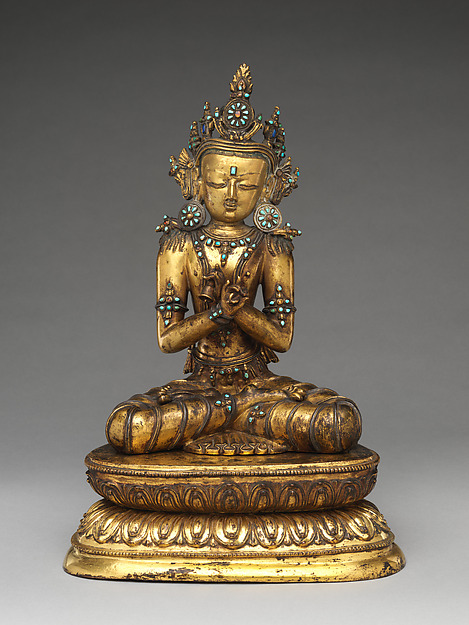
A fifteenth-century Tibetan sculpture of Vajradhara. The vajra and bell are held in hands crossed at the chest.
The Metropolitan Museum of Art, Bequest of W. Gedney Beatty, 1941, 41.160.97a, b. CC0. · Image source ↗ · CC0
In the library
The Gods of Northern Buddhism
Reading note
Read Alice Getty’s illustrated discussion of Ādi-Buddha.
Sources
See references (6)
- The Gods of Northern Buddhism, Reader page 54Alice Getty, The Gods of Northern Buddhism, 1928 revised second edition, Munshiram Manoharlal reprint. Lumitheca Library edition IMJ-0597-E001.Read this page in The Gods of Northern Buddhism ↗
- The Gods of Northern Buddhism, Reader page 55Alice Getty, The Gods of Northern Buddhism, 1928 revised second edition, Munshiram Manoharlal reprint. Lumitheca Library edition IMJ-0597-E001.Read this page in The Gods of Northern Buddhism ↗
- The Gods of Northern Buddhism, printed p. 4, Reader page 56Alice Getty, The Gods of Northern Buddhism, 1928 revised second edition, Munshiram Manoharlal reprint. Lumitheca Library edition IMJ-0597-E001.Read this page in The Gods of Northern Buddhism ↗
- The Gods of Northern Buddhism, Reader page 80Alice Getty, The Gods of Northern Buddhism, 1928 revised second edition, Munshiram Manoharlal reprint. Lumitheca Library edition IMJ-0597-E001.Read this page in The Gods of Northern Buddhism ↗
- The Powerful Prayer of Aspiration (Kunzang Mönlam), opening stanzas and Samantabhadra’s declaration, chapter 19 ↗The Powerful Prayer of Aspiration (Kunzang Mönlam), opening stanzas and Samantabhadra’s declaration, chapter 19. Source credit: revealed by Rigdzin Gödem, translated by Adam Pearcey for Lotsawa House.
- The Primordial Buddha Vajradhara ↗The Metropolitan Museum of Art, Bequest of W. Gedney Beatty, 1941, 41.160.97a, b. CC0.