An artist working between Europe and New Zealand
Born in Hamburg in 1866, Dittmer worked as a graphic artist in Germany and Paris before going to New Zealand near the end of the 1890s. He worked in Auckland, Taupō, Whanganui and Wellington, producing portraits and exhibiting with art societies. Printed reproductions carried his images to a wider public: the National Library records portraits published in the New Zealand Graphic and by the Christchurch Press.
His paintings belonged to a European market for images of Māori life. Christchurch Art Gallery’s account of The Alarm, painted in 1905, discusses the romantic conventions through which he presented its subject, and his use of photographs and sketches. Dittmer later returned to Europe. Te Tohunga appeared in 1907, and he died in Hamburg in 1909. Paintings, prints and copies of the book survive in New Zealand public collections.
Drawings first, stories around them
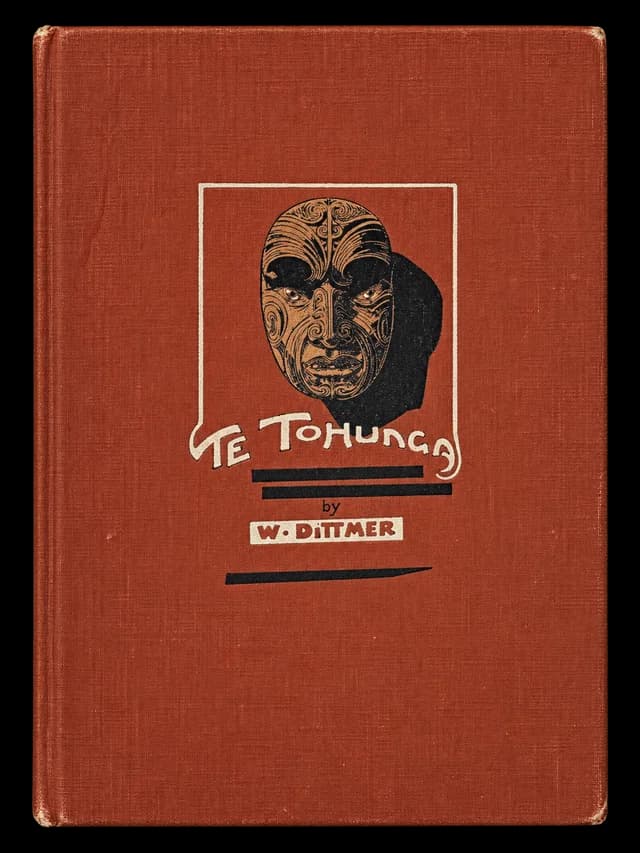
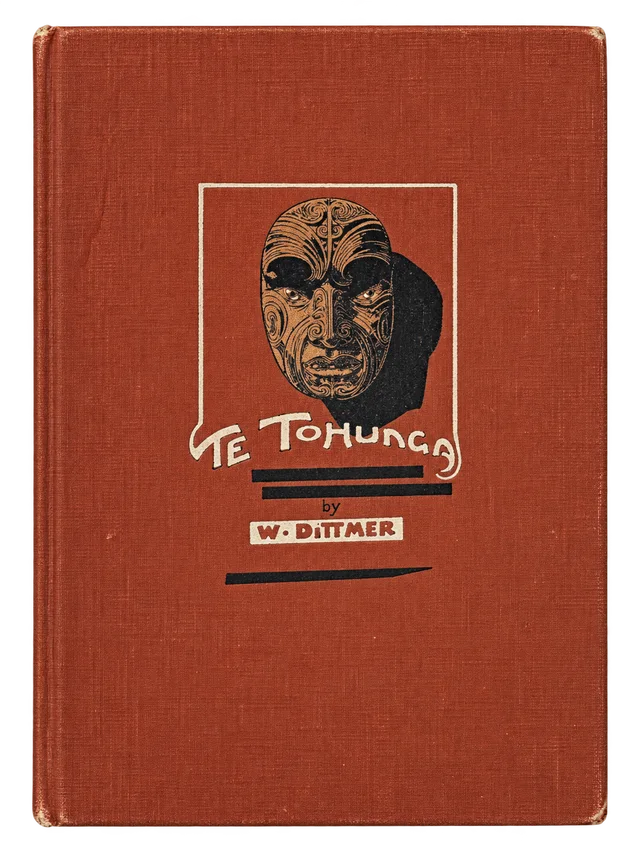
The held edition was published by George Routledge in London in 1907, with E. P. Dutton named for New York. Its title describes the traditions as orally collected and pictured by Dittmer. His preface gives a more complicated account of the process. Sketching carvings led to conversations with Māori acquaintances; their stories then stimulated further drawings. He also drew on published works by George Grey, Richard Taylor, John White and others, and thanked museum director Augustus Hamilton for encouragement and assistance.
The illustrations accompany creation stories, Māui’s adventures, Hinemoa, journeys and mourning. Three chapters in the contents are explicitly credited to James Cowan. Dittmer acknowledges that his main purpose was artistic and that the writing served the pictures. This helps define the book’s value and limits: it preserves his encounters with stories and visual forms, shaped by selection, reading and imagination. Its claim to present ancient tradition therefore needs to be understood alongside the named contributors and the artist’s own perspective.