Life and career
Thomas Witton Davies came to biblical scholarship through the Welsh Baptist ministry. He served a congregation in Merthyr Tydfil, then spent ten years teaching classics and Hebrew at Haverfordwest Baptist College. In 1891 he became principal of the Baptist College in Nottingham. Alongside that appointment he taught Arabic and Syriac, two languages that allowed him to compare the vocabulary of the Hebrew Bible with that of its neighbours.
While based in Nottingham, Davies studied in Leipzig and Strasbourg. In 1898 he returned to Wales to teach at Bangor. He held the university chair of Hebrew there from 1905 until 1921. Much of his personal library subsequently went to the National Library of Wales. His publications reached readers in both his working languages, from a Welsh introduction to the Old Testament to English commentaries on the Psalms, Ezra, Nehemiah and Esther.
Work and ideas
The title of his 1898 study identifies his method unusually precisely. Magic, Divination, and Demonology among the Hebrews and Their Neighbours examines the words used in biblical passages for the people who interpreted signs, consulted spirits or pronounced spells. A single familiar English word could conceal distinctions in the original. Davies approached those distinctions with the linguistic training he also brought to his commentaries.
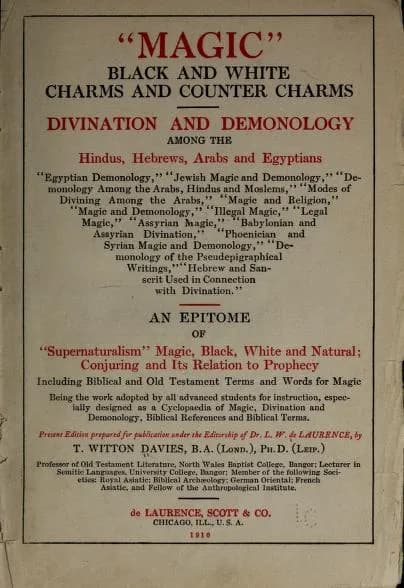
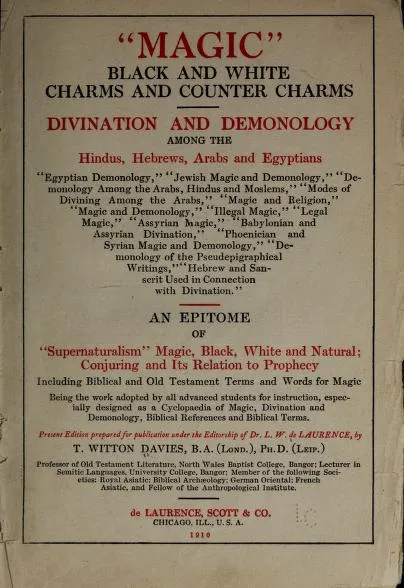
The Chicago edition issued by the occult publisher de Laurence gives the study a different setting. A Baptist scholar’s inquiry into the vocabulary and religious practices of antiquity had found another readership through the occult book trade. The 1898 title and Davies’s academic career help explain why so much of the book is devoted to the meaning of individual words.