Poetry, public speaking and political responsibility
Born at Hyderabad in 1879, Naidu went to Britain on a scholarship and studied at King’s College London and Girton College, Cambridge. Literary encouragement from English critics formed part of this early career. After returning to India she married the physician Govindarajulu Naidu in 1898. The Golden Threshold appeared in 1905, followed by further collections of English poems.
Campaigning for women’s political rights and Indian independence increasingly occupied her public life. She worked with Gandhi and other nationalist leaders, addressed audiences in India and abroad, and endured imprisonment. In 1925 she became the first Indian woman to preside over the Indian National Congress. At independence in 1947 she became governor of the United Provinces, holding office until her death in 1949.
Work and the stages of life in song
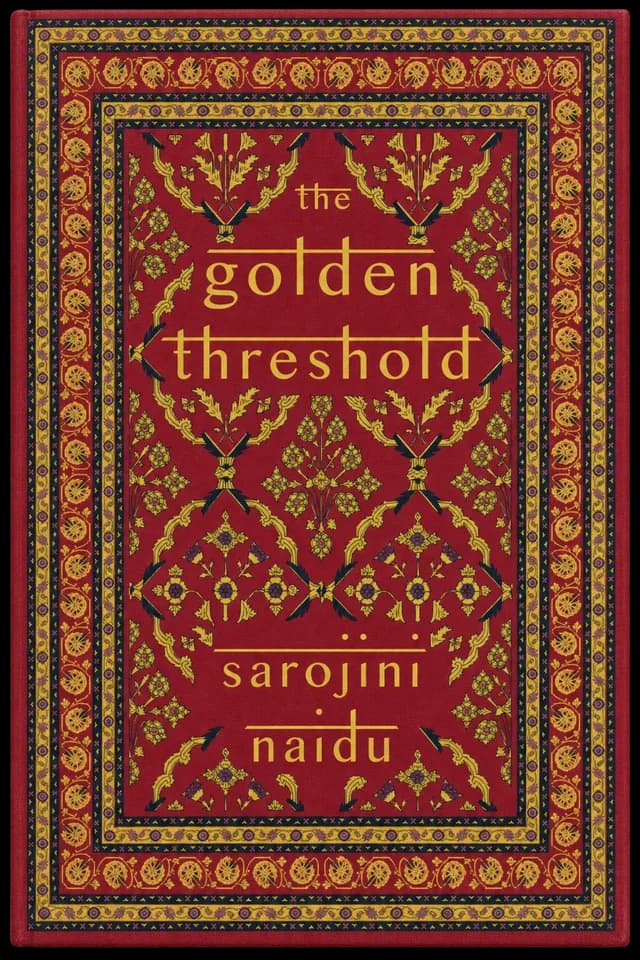
The Golden Threshold divides its poems into Folk Songs, Songs for Music and Poems. The undated reading transcription here includes Arthur Symons’s introduction. That essay offers a contemporary portrait of Naidu shaped by its own expectations of an imagined East; its voice remains distinct from hers.
Palanquin-Bearers makes the workers’ repeated movement carry its images of lightness. Indian Weavers gives morning, evening and night different colours and human occasions: a child’s garment, a marriage veil and a funeral cloth. Repeated questions hold the structure together while each answer changes its emotional meaning. Other collective speakers, including fishers and wandering singers, connect work, landscape and belonging. Refrain and address organise a relationship with an audience as closely as the decorative imagery shapes what it sees.