The stage, silent films and a wartime turning point
Born in Malvern, Worcestershire, in 1891, Woodman began acting in Shakespearean roles with the Benson Company. Estelle Stead’s account places him in her own touring Shakespearean company in 1912. His screen career included the silent films Nobody’s Child and Queen’s Evidence in 1919 and The Mystery Road in 1921. Scrapbooks preserved at the University of Tennessee contain film stills, portraits, reviews and publicity that document this side of his work.
Estelle recalled that Woodman stayed with her family at Cobham after being invalided out of the army in 1917. News that a close friend had been killed at the front prompted a much stronger interest in possible communication with the dead. According to her preface, he attended sittings with other mediums before discovering an ability to write automatically himself. Their subsequent collaboration developed alongside their ordinary work rather than replacing it. Woodman died in London in 1940; the surviving accounts give a clearer picture of his acting and Spiritualist associations than of his private life.
Recording The Blue Island
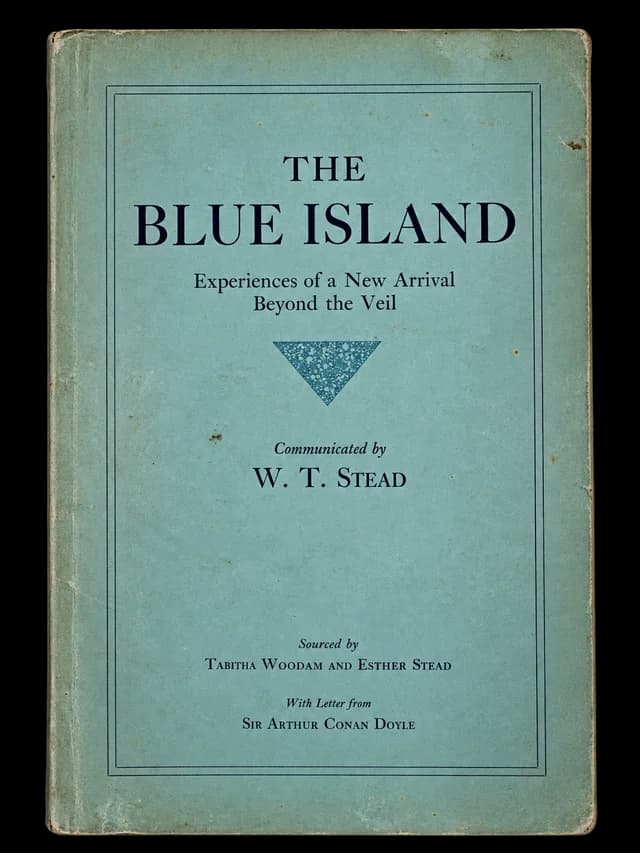
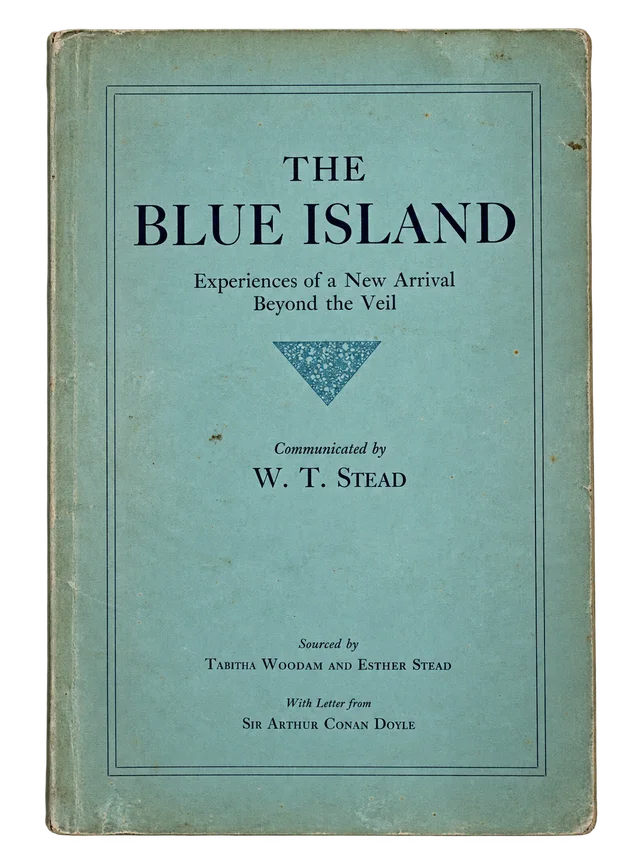
The held Hutchinson volume is the third edition of The Blue Island, first published in 1922. Its title says that the experiences were communicated by W. T. Stead and recorded by Woodman and Estelle Stead. In her preface, Estelle describes sitting with Woodman as he wrote with closed eyes. She traces the book’s preparation to messages obtained after earlier Armistice Day communications and says the sittings took several months.