From actor to astrological organiser
Born in Indiana in 1860, Hazelrigg worked as an actor in New York before making astrology his principal occupation. His interests extended into alchemy and older Hermetic literature. His Book of Formulas assembled writings associated with Paracelsus and other early authorities, while his own publications sought to explain the philosophical basis of astrology.
Metaphysical Astrology appeared in 1900, followed by an astrological periodical in 1901. In 1916 he helped establish the American Academy of Astrologians, whose meetings explored esoteric questions and whose proceedings he edited. He also collaborated with George J. McCormack on research connecting astrology and weather. These activities place him among the writers and organisers who sustained American astrology in the early twentieth century. He died in 1941.
Symbols, will and planetary influence
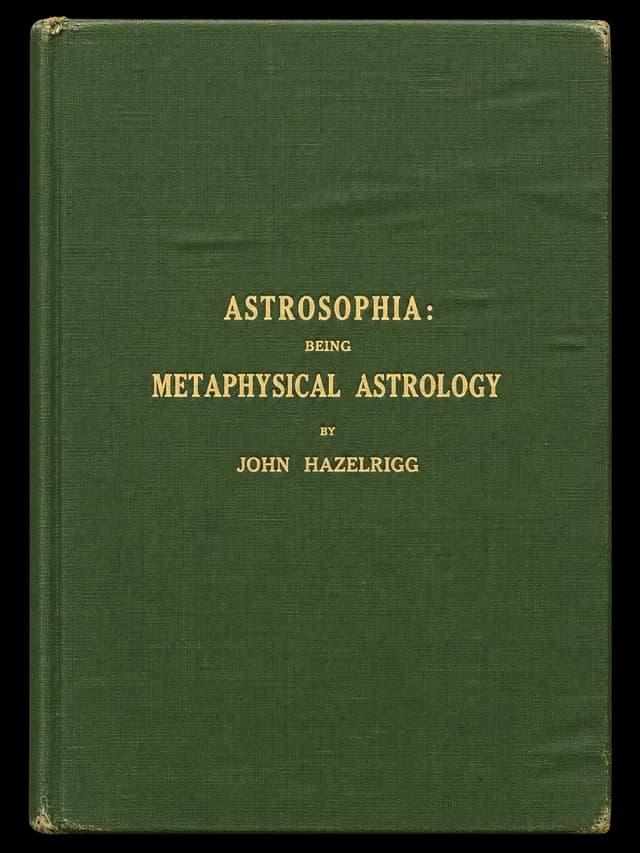
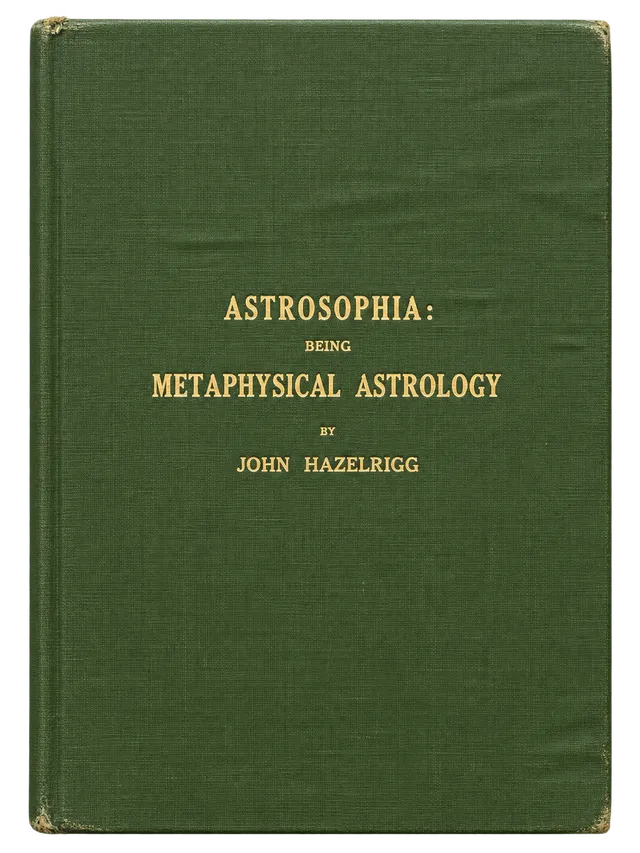
The held title page names Metaphysical Astrology and carries a 1900 copyright; the work also circulated under the title Astrosophia. Five chapters move from a rationale and an inductive approach to symbolism, eclipses and analogies in nature. Hazelrigg argues that astrology has been misunderstood, and draws on historical names and religious imagery to defend its standing.
His opening chapter resists a purely fatalistic reading of a birth chart. He proposes that planetary patterns correspond to the soul’s condition, while an informed exercise of will can change a person’s response to circumstances. Circle, crescent and cross become symbols for spirit, soul and matter. His account treats astrology as a metaphysical discipline, joining an interpretation of planetary patterns to the cultivation of will.