A life recorded by his institute
The Christian Institute’s history places Doumette’s birth in Syria in 1883, in a family of French Protestant missionaries. It describes travel through the Mediterranean, Middle East and Asia, followed by Red Cross service during the First World War. These early details come from the religious community he founded; independent documentation of his childhood and education remains limited in the sources consulted.
According to that account, he reached the United States after the war and settled in Kansas City, where he married Elizabeth Hockley. Together they organized the institute in 1933. Its magazine, Truth Review, followed in 1935. The couple moved to Southern California in 1941, and a Santa Monica church preceded the permanent headquarters established in 1948. Doumette continued as a minister and writer until his death in 1975.
Prayer and the inner Christ
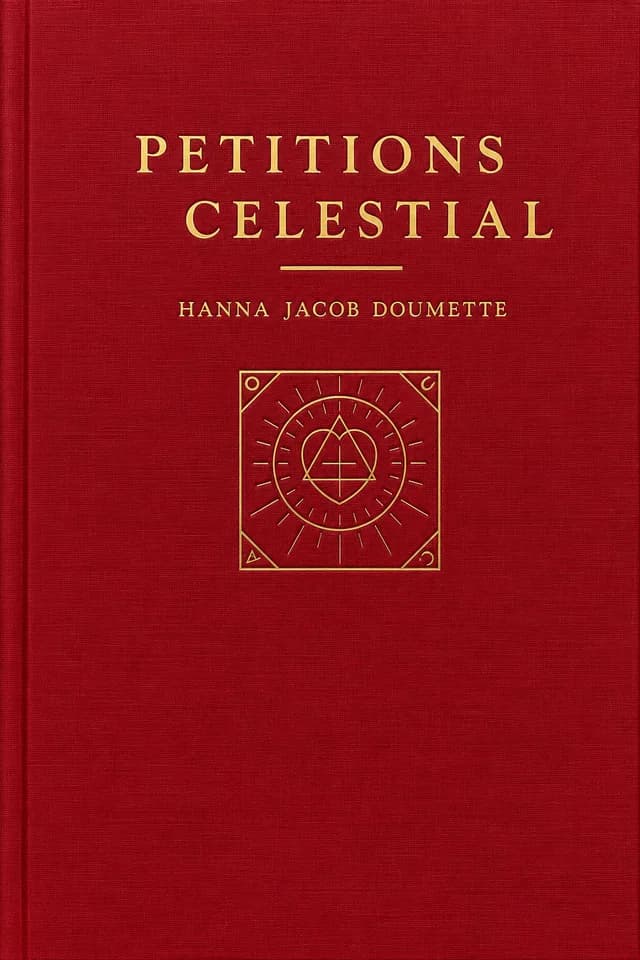
The preface to Petitions Celestial presents human existence as spiritual development toward union with God. Doumette argues that knowledge and material progress cannot bring that fulfilment by themselves. Meditation, devotion, love and service are the practices through which he expects the inner life to change. He extends the claim beyond personal experience, maintaining that humanity’s spiritual transformation would also change the forces of nature.
The opening address, O Christ Ever-Glorious!, is an extended prayer to Christ as a beloved presence. Images of light, nourishment, travel and homecoming give its repeated appeals an intimate voice. There Is Longing continues that devotional address, joining love for Christ to Doumette’s idea of an eternal self.
Other chapters explain the practices behind the prayers. Doumette reads the Lord’s Prayer as a sequence of inner changes: forgiveness transforms memory and character, while deliverance from evil becomes the birth of Christ within the individual. He also connects successive petitions with concentration, meditation and oneness with God. Familiar Christian language thus becomes a map of spiritual development in his teaching.
Books, booklets and a teaching community
The held title page names Sun Publishing Co. of Akron, Ohio, and identifies Doumette as the author of The Sun of Higher Understanding and The Mighty I. The book ranges from short prayers to discussions of prosperity, healing and biblical symbolism. In The Gospel of Prosperity, he attributes creative power to faith and will, but also calls for charity and service without seeking personal profit.
His teaching also circulated in shorter publications. The Graduate Theological Union lists a collection of his pamphlets dated approximately 1936. The reference work Encyclopedia of American Religions describes the Christian Institute of Spiritual Science and records such titles as After His Living Likeness and Jesus the Man. Its account emphasizes a divine Father, Mother and Son understood as principles present within human beings.
The final benediction repeats this movement from worship to inward realization. Doumette interprets the Father, Mother and Son as a divine presence within humanity, presenting communion with God as something to be experienced through the reader’s own consciousness.