A brief poetic career
Rimbaud grew up in Charleville, where his ability at school included composing Latin verse. His teacher Georges Izambard encouraged his literary interests. During the upheaval of the Franco-Prussian War he repeatedly tried to leave home. He sent poems to Paul Verlaine, whose invitation brought him into the Paris literary world.
The two poets became lovers and travelled together in Belgium and England. Their relationship ended violently in Brussels in 1873, when Verlaine shot and wounded Rimbaud. A Season in Hell appeared later that year. Rimbaud’s poetic activity was largely over by the middle of the decade. He subsequently travelled and worked abroad, including as a trader in Africa. Illness brought him back to France in 1891; he died in Marseille after an operation to amputate his leg.
The poem and its interpreters
A Season in Hell does not settle into one continuous confession. Its speaker accuses, remembers and contradicts himself, drawing on Christian ideas of sin and salvation while testing the extravagant hopes he had placed in poetry. In Alchemy of the Word, an experiment in language is recalled with both fascination and distrust. The closing Adieu faces the difficulty of returning to ordinary, embodied life.
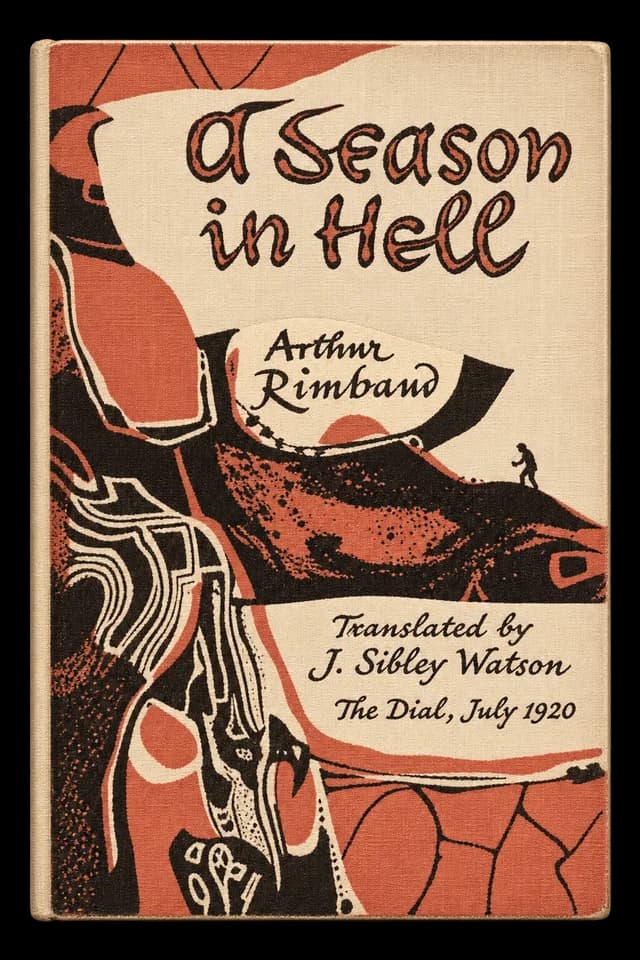
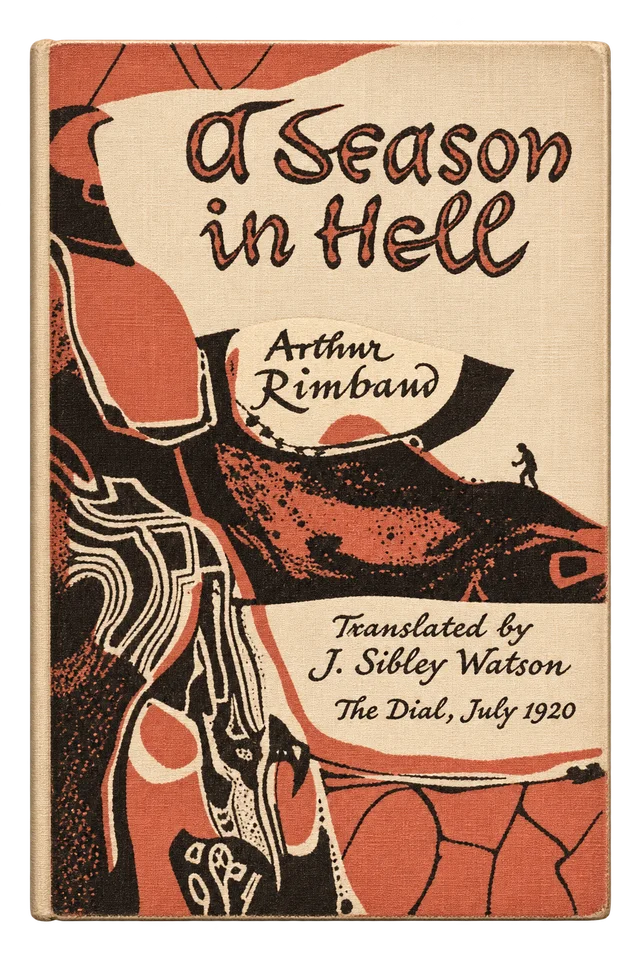
The English version held here is J. Sibley Watson’s translation, published in The Dial in July 1920. Watson’s prefatory note relates the poem to Rimbaud and Verlaine. That explanation belongs to the translator’s interpretation: the poem’s changes of voice and abrupt reversals cannot always be reduced to a corresponding incident in the poet’s biography. The original composition dates and the later English publication mark separate stages in the work’s history.