From public performance to New Thought
McIvor-Tyndall became known as a hypnotist and stage mind-reader. His best-publicised feats included driving a carriage through busy streets while blindfolded, guided, he claimed, by another person’s thoughts. The journalist and novelist Theodore Dreiser witnessed his work and later recalled its powerful effect on his interest in psychology. Such performances belong to the history of theatrical mentalism; the response of an impressed spectator does not establish telepathy as their explanation.
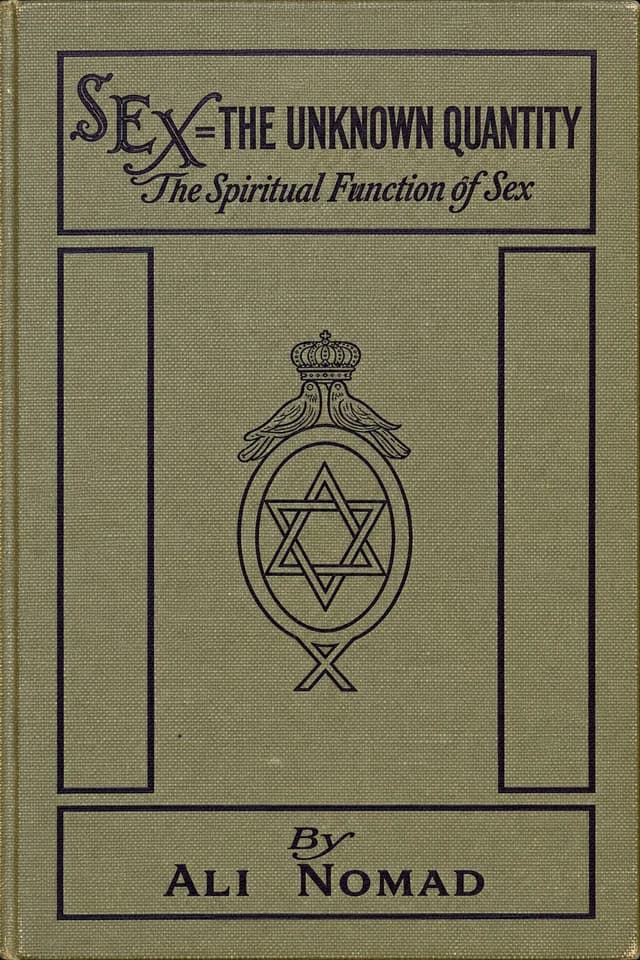
By the early twentieth century McIvor-Tyndall was also offering mental-healing instruction and courses in psychic science. He worked as New Thought editor of the Denver Post and edited The Swastika: A Magazine of Triumph, whose surviving first issue dates from January 1907. Through the International New Thought Fellowship and related centres, his teaching reached beyond the platform into lessons, magazines and organised groups. As Ali Nomad he published Cosmic Consciousness in 1913 and Sex—The Unknown Quantity in 1916. His personal relationships also attracted publicity: a 1917 newspaper report portrayed conflict involving Margaret, his former partner, and Laura, his new wife.
Sex as a spiritual principle
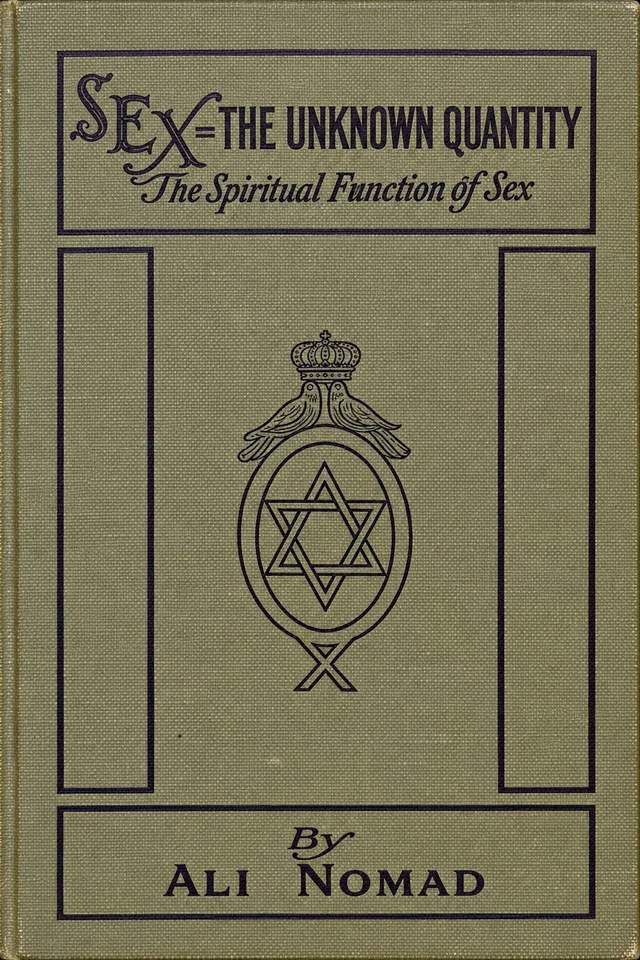
The held Chicago edition of Sex—The Unknown Quantity was issued by Sterling Publishing Company in 1916. Its title page prints both Ali Nomad and Alexander J. McIvor-Tyndall, making the connection explicit. The introduction sets aside physiological instruction to concentrate on sexuality’s spiritual function. The argument treats attraction, polarity and the union of masculine and feminine principles as expressions of a force operating throughout the universe.